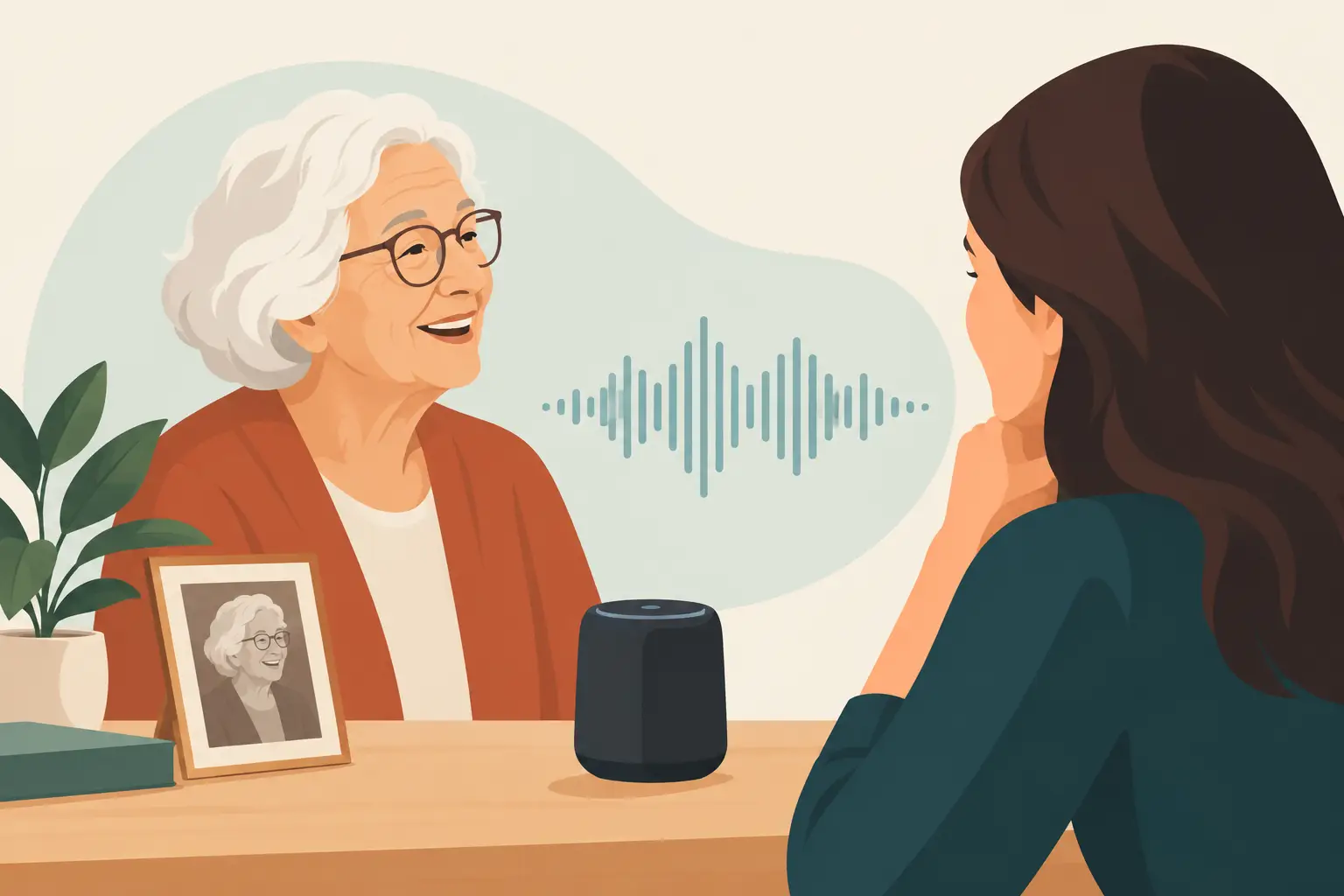
How to Preserve Your Grandmother's Voice
Learn how to preserve your grandmother's voice with simple, private recordings, meaningful prompts, and a keepsake your family can revisit for many years.
There may come a day when you remember exactly how your grandmother laughed, or the small pause she took before telling a story, but cannot quite hear it. Learning how to preserve your grandmother's voice is not only about saving words. It is about keeping the person inside them: her humor, her rhythm, the phrases only she uses, and the warmth your family knows by heart.
You do not need a studio, a complicated app, or a formal interview to begin. What matters most is making space for her to speak while she can, in a way that feels comfortable and private.
Why her voice is worth saving
A written family story is a gift. But a transcript cannot carry everything. It cannot fully show the smile in her voice when she recalls meeting your grandfather, the certainty in her answer when she talks about raising children, or the tenderness that appears when she says your name.
Her voice also holds details that may never make it into a family history otherwise. A recipe becomes more than a list of ingredients when she explains why the pie crust must rest. A story about a first job becomes vivid when you hear her describe the bus ride, the shoes she wore, or the person who gave her a chance.
The goal is not to create a perfect record of an entire life. That pressure can stop a project before it starts. The goal is to preserve real moments in her own voice, a few minutes at a time.
How to preserve your grandmother's voice without making it difficult
The best recording method is the one she will actually use. For many grandparents, that means keeping the process simple: one question, one recording, and no technology lesson before they can begin.
Start by asking permission in a gentle, direct way. You might say, “I would love to save some of your stories so we can hear them in your voice in the future. Would you be comfortable answering a few questions?” Make clear that she can skip anything she does not want to discuss, stop whenever she wants, and ask for a recording to be deleted.
That permission matters. A voice is personal. Treating it with care helps the experience feel like a conversation, not a task she owes anyone.
Choose questions that invite stories
Broad questions such as “Tell me about your life” can feel overwhelming. Specific questions give her somewhere easy to begin. Ask about ordinary memories as well as major milestones. Often, the ordinary details become the most treasured ones.
Try prompts such as: “What did your home smell like when you were a child?” “Who made you feel safe growing up?” “What was your first paycheck spent on?” “What did you love about being a mother or grandmother?” “What do you hope the younger people in our family understand?”
Let her answer one question at a time. A short recording about her favorite school lunch may lead, unexpectedly, to a story about her own mother. Follow the feeling of the conversation rather than trying to finish a questionnaire.
It also helps to ask questions that leave room for her personality. Invite her advice, her opinions, and her funny memories. The recording does not need to be solemn to be meaningful. Her teasing, her expressions, and the stories that make everyone laugh are part of what you are trying to keep.
Make recording easy enough to repeat
A phone can make a clear recording, but the setup should feel manageable for her. Choose a quiet room, turn off the television, and place the phone within easy reach. Sit close enough to hear her comfortably without asking her to raise her voice.
If you are recording in person, begin with a short test. Play it back and make sure you can understand her. You do not need perfect sound. A little room noise is far less important than having the recording at all. Still, a quiet space and a phone placed about a foot or two away will usually give you a better result than recording across a large room.
For a grandmother who lives far away, avoid asking her to download software or remember a password if that will become a barrier. A simple phone-browser recording link can be easier. Tell Me Forever, for example, sends private one-question-at-a-time links that let a storyteller record directly from a phone browser. There is nothing to install, no account, and no password.
Whatever method you choose, keep sessions short. Ten or fifteen minutes may be plenty, especially if she gets tired easily or finds long conversations taxing. You can return another day. The project does not need to happen all at once.
Let her set the pace and the boundaries
Some memories will be easy to tell. Others may carry grief, family conflict, illness, or experiences she has spent years trying to put into words. Do not press for the version of a story you think you need.
If she changes the subject, let her. If she wants to record an answer again, give her time. If she tells a story differently from the way you remember it, preserve her account without correcting it in the moment. Family history can hold more than one perspective.
This is especially true when memory is changing. A grandmother may repeat herself, lose a date, or blend parts of a story together. Her voice still has value. Focus on what she wants to share now. If accuracy is important for a particular detail, you can later label it as a family recollection rather than trying to turn every recording into a historical document.
Save more than the audio file
Recording is the first step. Preservation means making sure the voice remains accessible, understandable, and safe years from now.
Keep the original recordings in more than one place. Save a copy on a computer or external drive and another in a secure cloud storage account. Use clear file names that include the date and subject, such as “Grandma_Maria_FirstApartment_March2026.” A recording called “audio_1047” may be hard for someone else to identify later.
Written transcripts are worth keeping alongside the audio. They make it easier for relatives to find a story, especially if someone cannot hear well or wants to read along. But keep the original sound file, too. The transcript preserves what she said. The audio preserves how she said it.
A physical book can give the collection a home that does not depend on a device or a login. If audio is paired with each printed story through a scannable code, family members can read her words and then hear her tell them. That combination can be especially meaningful for children and grandchildren who may one day know her through these recordings.
Include the stories that are happening now
People often begin with childhood, marriage, work, and major family events. Those stories matter. So do the smaller recordings from the present.
Ask her what she has been thinking about lately. Record her description of the neighborhood, the season, a holiday meal, or the view from her window. Invite her to leave a message for a new baby, a graduating grandchild, or someone facing a hard season. These recordings need no long preparation. They simply let her speak to the people she loves.
You can also preserve the familiar things your family might otherwise lose: the way she explains a family recipe, a prayer or song she knows by heart, the story behind a nickname, or the advice she gives when someone is worried. These are not minor details. They are the texture of belonging.
Do not wait for the perfect occasion
It is natural to think you need a holiday gathering, a finished list of questions, or an uninterrupted afternoon. In practice, waiting for the ideal moment can quietly become waiting too long.
Begin with one question. “What do you remember about the house where you grew up?” is enough. So is, “What would you like me to remember about you?” If she answers for two minutes, you have two minutes of something your family did not have before.
One day you will want to hear her voice again. Give your future family the chance to press play.