35 Family History Interview Questions to Ask
Thoughtful family history interview questions help you preserve a parent's or grandparent's stories, voice, and small details before they fade from view.
A date of birth can tell you when someone arrived. It cannot tell you how your grandfather felt on his first day of work, why your mother kept a particular recipe card, or what your grandmother's laugh sounded like when she remembered her sister. The right family history interview questions make room for the details that will matter most later: the ordinary days, the turning points, and the words only they would use.
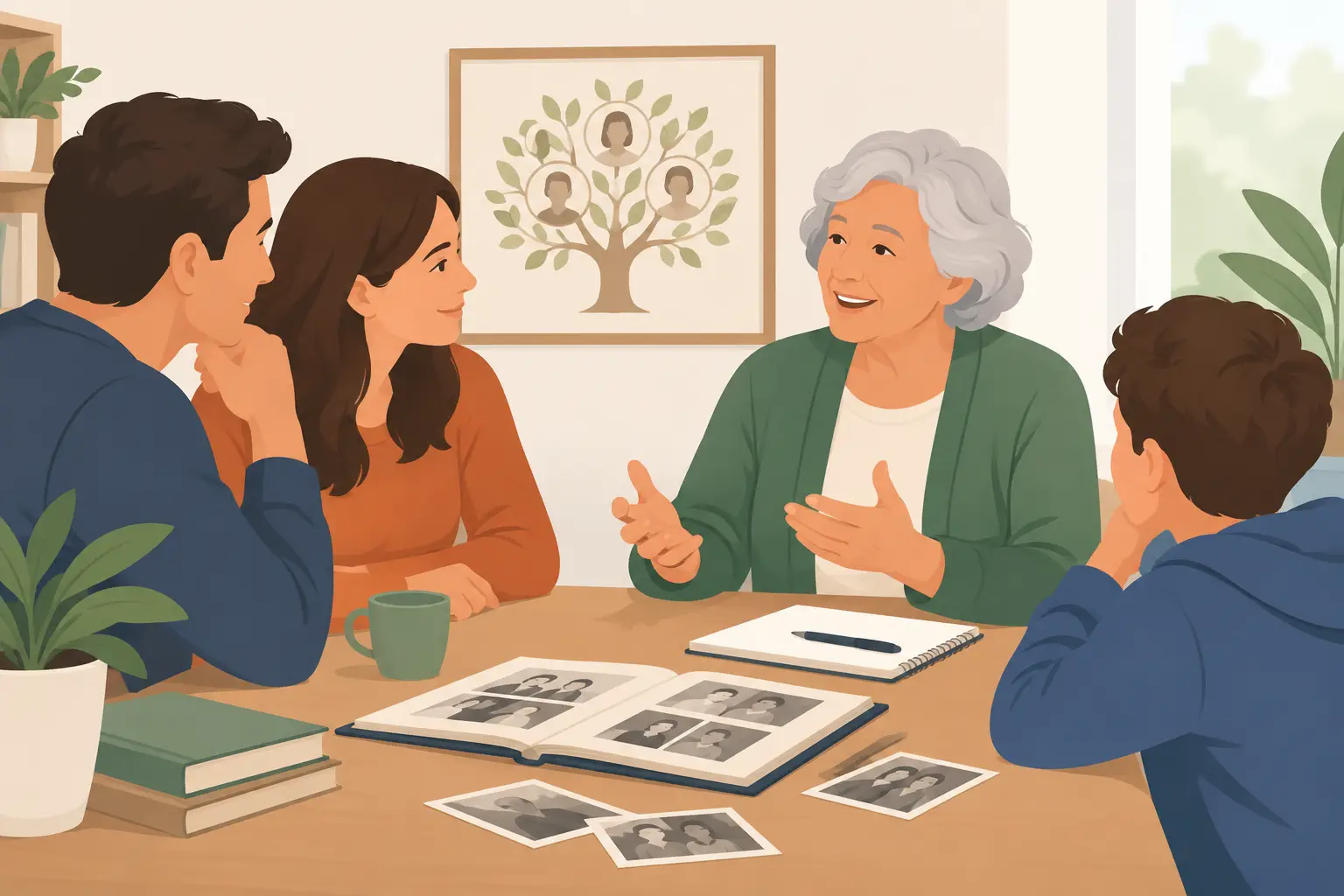
This does not need to feel like a formal interview. In fact, it usually goes better when it does not. Ask one question at a time. Give the person time to think. Let a story wander a little. A memory that begins with a school bus or a kitchen table may lead somewhere no family tree could reach.
How to ask family history interview questions well
Begin with questions that feel easy to answer. Childhood routines, favorite foods, pets, and old neighborhoods can help someone settle into the conversation. More emotional subjects may come later, if they come at all. There is no prize for covering every chapter of a life in a single sitting.
Be prepared to follow the story rather than your list. If your dad mentions the neighbor who taught him to drive, ask what that neighbor was like. If your aunt pauses at a difficult memory, do not rush to fill the silence. You can offer to move on, return to it another day, or simply let the subject rest.
It also helps to ask for scenes rather than facts. “What was your home like?” often brings fuller answers than “Where did you live?” “Tell me about a meal you remember” can reveal more about family life than “What did your family eat?” Specific questions give memory something to hold.
If recording the conversation, say so clearly before you begin. Explain who will be able to hear it and where it will be kept. Some people speak more freely knowing their stories will stay private. Others appreciate the chance to leave a message in their own voice for children and grandchildren. Either way, consent and comfort come first.
Family history interview questions about childhood
Childhood questions often open the door gently. They also preserve the texture of a time that may otherwise disappear: the sounds of a neighborhood, the rules of a household, what counted as a special treat.
- What is your earliest memory?
- What was the home you grew up in like?
- Who lived with you when you were young?
- What did a normal school day look like for you?
- What games did you play, and who did you play with?
- What food or smell takes you straight back to childhood?
- What were your parents or caregivers like at home?
- Did your family have sayings, traditions, or rules that you still remember?
- What did you dream of becoming when you grew up?
A useful follow-up is, “Can you picture the room?” It invites details such as a coal stove, a porch swing, a radio playing in the next room, or a sibling always claiming the best chair. Those details are often what younger relatives remember most.
Questions about family, belonging, and tradition
Families are not only names and dates. They are inside jokes, hard-won lessons, holidays that ran late, and the people who showed up when things went wrong. These questions can be meaningful, but they may also touch on grief, estrangement, adoption, divorce, or other sensitive history. Ask with care, and accept a brief answer if that is what someone prefers.
- Who made you feel most understood when you were young?
- Which relative do you think you resemble most, and why?
- What family story was told again and again?
- What traditions did your family keep, change, or leave behind?
- What did celebrations look like in your family?
- Was there a place where your family gathered often?
- What values did your parents try to pass on?
- What is something about your family that people outside it might not understand?
- What do you wish you had asked an older relative before they died?
That final question can lead to an especially honest conversation. It may also explain why this recording matters to them. Many people understand the value of being asked because they carry their own unanswered questions.
Questions about work, love, and turning points
A life is often shaped by decisions that looked small at the time: taking a job, saying yes to a date, moving across town, speaking up, or choosing not to. Let the storyteller decide which events deserve space.
- What was your first job, and what did it teach you?
- Which job changed your life the most?
- How did you meet the people who became most important to you?
- What do you remember about falling in love?
- How did you decide where to live or raise your family?
- What was one difficult decision you had to make?
- When did you feel especially proud of yourself?
- Was there a time your plans changed completely?
- What risk are you glad you took?
Do not assume that marriage, parenthood, or career are the central parts of every life. For one person, the defining chapter may be military service, friendship, faith, caring for a sibling, surviving an illness, making art, or finally finding a place where they belonged. Open questions leave room for the story they consider most true.
Questions that preserve a person's voice and perspective
Facts can be researched later. Personal perspective cannot. These prompts help preserve the way someone sees the world, including the humor, wisdom, and small preferences that make their voice familiar.
- What always makes you laugh?
- What is something you are better at than most people realize?
- What advice do you find yourself giving again and again?
- What have you changed your mind about over the years?
- What was considered normal when you were young that would surprise people now?
- What object in your home has the most meaning to you?
- What place do you still miss?
- What do you want your children or grandchildren to understand about your life?
- What would you like to say directly to a future member of the family?
The last few questions work particularly well as spoken recordings. One day, a typed sentence may be treasured. Hearing the pause before it, the familiar phrasing, or a laugh after a remembered mistake can mean something different. One day you will want to hear her voice again.
Make the project easy enough to begin
The best question list is not the longest one. It is the one your loved one will actually answer. Start with five or ten prompts, especially if recording feels new or tiring. You can always add more later. A 10-minute story told with warmth is more valuable than an hour that leaves someone exhausted.
Choose a quiet time of day and a familiar place. A photo, recipe, old letter, or piece of music can help bring memories forward, but do not turn preparation into a barrier. The conversation matters more than perfect lighting, polished answers, or a complete chronology.
For relatives who are uneasy with technology, remove as much friction as possible. Tell Me Forever lets a storyteller receive one private question at a time through a simple link. There is nothing to install, no account, and no password. They can record directly from a phone browser, while the family receives both the written story and the original voice in a printed keepsake.
Not every memory needs to be shared with everyone. Decide early whether recordings are for immediate family, a smaller group, or the storyteller alone for now. Respecting those boundaries can make it easier for someone to speak honestly. You can also give them the chance to listen back, revise a detail, or remove an answer before it is included.
A good first question is often the simplest one: “What do you remember about the house where you grew up?” Ask it while you can. Then listen long enough for the next memory to arrive.