A Book With QR Code Audio Keeps Voices Close
See how a book with QR code audio preserves a parent’s stories on paper and in their own voice through a simple, private process with no account needed.
A photograph can show you your father at 25. A written memory can tell you what he hoped for then. But one day, you may want something more specific: the pause before he answers, the laugh in the middle of the story, the familiar way he says your name. A book with QR code audio keeps those parts together - the words on the page and the voice that first gave them life.
For families trying to preserve a parent’s or grandparent’s history, that combination matters. A printed book is easy to hold, pass around, and keep on a shelf. Audio carries personality, cadence, humor, and feeling that a transcript alone cannot fully contain. The QR code creates a simple bridge between the two.
What is a book with QR code audio?
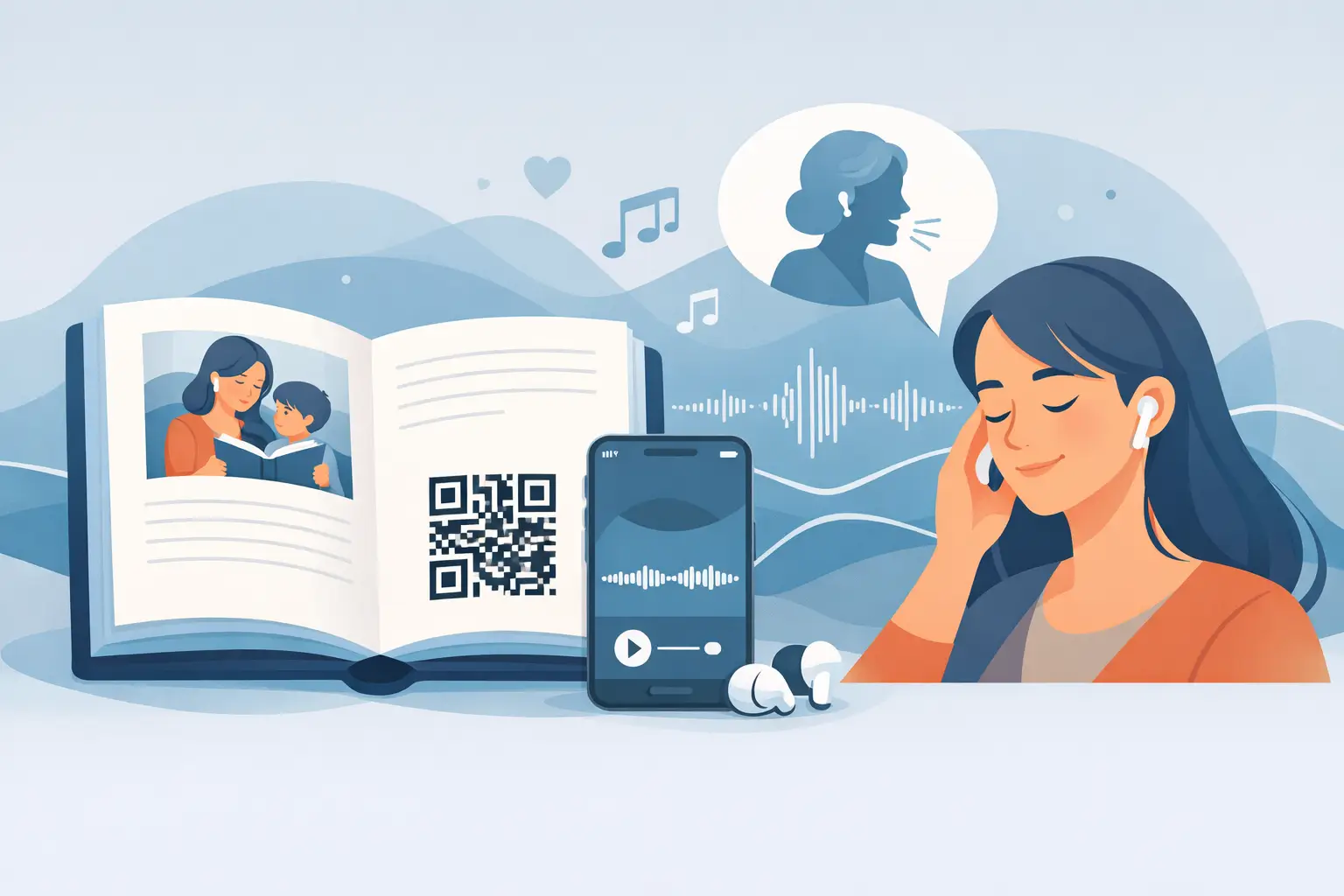
It is a printed life-story book with a small scannable QR code placed beside each recorded story. A family member opens their phone camera, points it at the code, and hears the original recording.
The text still has its own purpose. It makes a story easy to read quietly, revisit, and share with someone who may not be in the room. The audio adds the storyteller back into the moment. You do not have to choose between a beautiful written record and the voice behind it.
Imagine reading your grandmother’s account of meeting your grandfather, then scanning a code to hear her tell it herself. Perhaps she changes the details halfway through. Perhaps she laughs at the part the family has heard many times. Those small, unscripted moments are often what people treasure most later.
Why the voice changes the book
Families often begin a memory project because they are afraid stories will disappear. That concern is real. A relative may have told the same story for decades, but no one has written it down. Or everyone assumes someone else will ask the questions someday.
Written stories preserve facts and reflections. Audio preserves presence.
A voice can reveal tenderness when someone talks about a childhood home. It can carry pride in a story about work, military service, raising children, or starting over after a hard season. It can also make room for ordinary details that would otherwise be lost: the name of a neighborhood store, a favorite family saying, the way a parent describes their own mother.
This does not mean every recording has to be polished. In fact, it usually should not be. A slightly wandering answer, a breath before a difficult memory, or a gentle correction can make the story feel more human. The goal is not a formal oral-history production. It is to keep a loved one’s account in a form your family can return to.
The best process asks very little of the storyteller
The idea of recording a life story can sound intimidating, especially for someone who does not enjoy technology or does not want to feel interviewed. The right process should feel closer to receiving a thoughtful question from family than learning a new system.
With Tell Me Forever, the family chooses or customizes prompts, then the storyteller receives one private question at a time by email. They tap the link in a phone browser and record an answer with a single button. There is nothing to install, no account, and no password.
That simplicity is more than a convenience. It removes the reason many projects never begin.
A parent may be happy to answer, but reluctant to download an app. A grandparent may not want to remember another login. Someone may need time between questions, especially if the memories are personal. Sending one question at a time gives each story room to arrive naturally.
The person organizing the book can also choose the pace. Questions can be spaced out so the project does not feel like homework. A simple prompt such as “What did your home feel like when you were young?” may bring out far more than a broad request to “tell your life story.”
Choosing questions that invite real stories
Good questions are specific enough to start a memory, but open enough to let the storyteller decide what matters. Questions about first jobs, family meals, school, friendships, moves, holidays, traditions, and turning points often lead to stories children and grandchildren have never heard.
It helps to balance light questions with deeper ones. Ask about music, pets, mischief, favorite places, and what a normal Saturday looked like. Then make room for questions about love, loss, values, resilience, and the lessons they hope to pass on.
There is no requirement to cover every year of a person’s life. A shorter collection of meaningful stories is better than an exhausting project that is never finished. Some families focus on a single chapter, such as childhood, parenthood, immigration, a marriage, or service in the community. Others build a broader book over time.
There is also value in letting a storyteller skip a question. Privacy and dignity matter. A memory book should never pressure someone to explain an experience they would rather keep private. The most lasting books are honest about what they include and respectful about what they do not.
How QR code audio works in the finished book
Once recordings are complete, the spoken answers can be transcribed and carefully typeset into a physical paperback or hardback book. Each story appears in writing with its corresponding code nearby. The printed page becomes the starting point, not the end of the experience.
Scanning is familiar to most families now. Open a smartphone camera, point it at the code, and follow the prompt on screen. No special QR code app should be necessary. A child can listen beside a grandparent. A sibling in another state can scan the same page in their own copy. Years later, a grandchild can hear a voice they may barely remember.
The recordings and transcripts should also be available to the family outside the book. A physical book is a lasting keepsake, but digital copies provide another layer of protection and flexibility. You may want to save an audio file, print an extra transcript, or share a recording privately with close relatives.
The practical details matter here. Ask how long recordings can be, whether you can review or edit a response, how privacy is handled, and what happens if you want additional copies later. A thoughtful service will make those answers clear before you begin.
A printed book is still worth having
It is reasonable to wonder whether audio alone is enough. Phones already hold voice memos, videos, and messages. But files can become scattered. They are easy to forget, difficult to browse, and rarely placed in the hands of the people who would value them most.
A book gives family memory a home. It is visible. It can sit beside photo albums, be wrapped as a gift, or be opened during a holiday gathering. The QR codes do not replace the experience of reading. They make the book richer when a reader wants to hear more.
The format also respects different generations. Some relatives will prefer to read every page. Others will go straight to the codes and listen. A family does not have to preserve memories in only one way.
Begin while the questions can still be asked
People often postpone this kind of project because they want to find the perfect time, perfect questions, or perfect way to say how much it matters. But a simple first question is enough.
Ask your mother what she remembers about her first home. Ask your grandfather about the person who taught him the most. Ask your aunt what she hopes the family never forgets. Let the answer be imperfect, funny, brief, or unexpectedly moving.
A book with QR code audio gives those answers a place to live. More importantly, it gives your family a reason to hear them now - while the voice is still there to answer.