Capture Family Recipes in Voice, While You Can
Learn how to capture family recipes in voice, preserving the stories and small details a written card may leave out for one family's future generations.
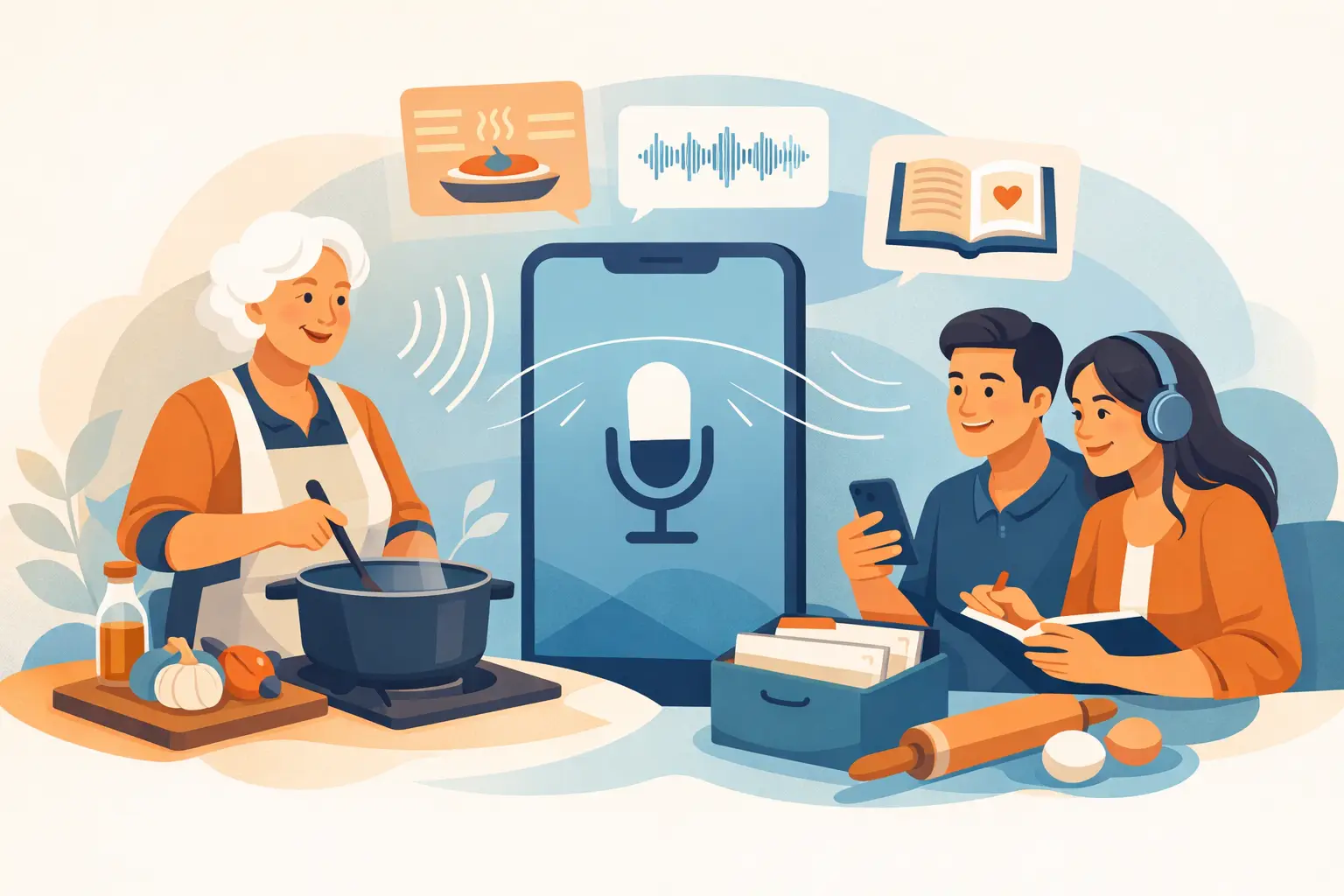
A recipe card can tell you to bake at 350 degrees. It cannot tell you why your grandmother always checked the oven five minutes early, which cousin asked for a second helping every Thanksgiving, or how the kitchen smelled when the cinnamon rolls were ready. To capture family recipes in voice is to preserve the part of the meal that lived outside the measurements.
That difference matters more than most families realize. A handwritten recipe is valuable. A spoken recipe, in the cook's own voice, holds the pauses, the laughter, the confidence behind “you'll know when it looks right,” and the stories that explain why a dish became part of the family in the first place.
Why family recipes need more than a recipe card
Many beloved recipes were never written down carefully. They were learned by watching. A parent may say, “I just add enough,” because their hands have been doing it for 40 years. A grandparent may use a coffee cup instead of a measuring cup, or refer to an ingredient by a brand name that disappeared decades ago.
Trying to turn that knowledge into a perfect written recipe can feel frustrating. It is still worth doing, but it should not be the only goal. The voice recording can hold the uncertainty honestly: how the dough should feel, what “a pinch” means in their kitchen, and what to do when the sauce breaks. Those details give the next generation a better chance of making the dish, even when the written instructions are incomplete.
More quietly, food memories often open doors that direct life-story questions do not. Ask someone about their first job, and they may give a short answer. Ask about the cake they made for their first birthday as a newlywed, and suddenly you hear about the first apartment, the neighbors, the tiny stove, and what life felt like then.
Start with one dish, not the whole cookbook
The easiest way to begin is to choose a recipe that already has a story attached to it. It might be the potato salad that appears at every reunion, Dad's Sunday gravy, the cookies your children associate with sleepovers, or the dish nobody else has ever been able to make quite right.
Beginning with one recipe keeps the conversation warm and manageable. You do not need an afternoon of formal interviewing. A few unhurried minutes can preserve something irreplaceable.
Before recording, gather what you can. Put the recipe card, an old cookbook, or a familiar pan nearby. If possible, have the person make the dish or talk through it while looking at the ingredients. Physical objects bring back specific memories. They can also help clarify a step that has become automatic.
It helps to accept that the first recording may not be perfectly organized. That is not a failure. You can return with a follow-up question later, such as, “When do you add the vanilla?” or “What did you mean by a medium-hot oven?” A family recipe was rarely passed down in one tidy session. Its recording does not need to be either.
Questions that bring a recipe to life
A good prompt is specific enough to be easy to answer, but open enough to invite a memory. Instead of asking, “Can you share your lasagna recipe?” try asking, “When did you first start making this lasagna, and who taught you?” The recipe will often emerge naturally from there.
As the conversation continues, ask for the practical information: the ingredient amounts, order of steps, cooking time, temperature, pan size, and how many people it serves. Then make room for the knowledge that is harder to write down. Ask what the finished dish should look, smell, or feel like. Ask which substitutions are acceptable and which ones would change it too much.
These questions can help:
- What is the first thing you do, before you begin cooking?
- How do you know this is ready if you are not using a timer?
- Who taught you the recipe, and what do you remember about them?
- When did our family usually eat this?
- What mistake should someone avoid the first time they make it?
- If you could only give one piece of advice for this dish, what would it be?
The point is not to extract a performance. Let your loved one wander a little. The story about the missing ingredient, the old grocery store, or the meal made during a difficult year may become the part everyone treasures most.
Make recording feel simple for the storyteller
Technology should not become the reason this project never happens. If a parent or grandparent is hesitant about recording, reassure them that they do not need to learn a new system. The best process is one that lets them answer from a phone browser with nothing to install, no account, and no password.
Send one question at a time. A single prompt feels like a conversation, not an assignment. It also gives the storyteller time to answer when they feel comfortable, rather than asking them to sit down for a long session on someone else's schedule.
Encourage short recordings. One question, one answer, then a pause. A five-minute memory can be more meaningful and easier to revisit than a 45-minute recording that tries to cover everything at once. If they lose their train of thought, that is fine. Start again, or move to the next question. The sound of a real person thinking is part of what makes the recording theirs.
Choose a quiet place when you can. Turn off a television, set the phone nearby, and speak naturally. Do not worry about having a professional voice or a perfect kitchen. The goal is not polished audio. It is a familiar voice saying, “This is how I always made it.”
Turn spoken memories into something usable
Voice alone preserves the feeling of the recipe, but written instructions make it possible to cook from it. Ideally, keep both. A transcript can be gently organized into ingredients and steps while preserving the original language in the accompanying story.
Be careful not to edit away the personality. If Grandma says, “Use the good butter,” that belongs in the recipe. You may add a clarifying note about the amount, but the original advice is part of the inheritance. The same is true when a cook cannot name an exact measurement. Rather than pretending the recipe is more precise than it is, write the approximation and include their description of what to look for.
This is also a good moment to verify the recipe. Make it with them if possible. Read back the steps and ask whether anything is missing. You may discover that the “secret” ingredient was added at the end, or that the recipe makes twice as much as anyone expected. A test batch can turn preservation into a family afternoon.
Tell Me Forever can make this process gentler by collecting spoken answers through simple private links, then providing written transcripts alongside the original recordings. In a printed life-story book, a scannable code beside a story can let future readers hear the voice behind the words. For a recipe, that means the instructions can sit on the page while the cook's own explanation remains close at hand.
Decide what should stay private
Recipes are usually joyful, but the memories around them can be tender. A dish may bring up a marriage, a loss, money troubles, immigration, illness, or a family disagreement. Your loved one should always decide what is recorded and who can hear it.
Keep recordings private unless the storyteller wants them shared. If a story feels too personal for a printed book, it can remain an audio memory for close family. If a recipe is meant for everyone, a written version can be shared more widely while the fuller spoken story stays within the family.
There is no single right format. Some families will want a complete recipe collection. Others will preserve only a few dishes and the voices connected to them. The right choice is the one your loved one can begin without feeling pressured.
The next time you ask for the recipe, consider asking for the story too. Put the phone on the table, let the conversation take its time, and listen for the details that no measuring spoon can hold. One day, someone you love may make that dish and be grateful to hear exactly how it was done.