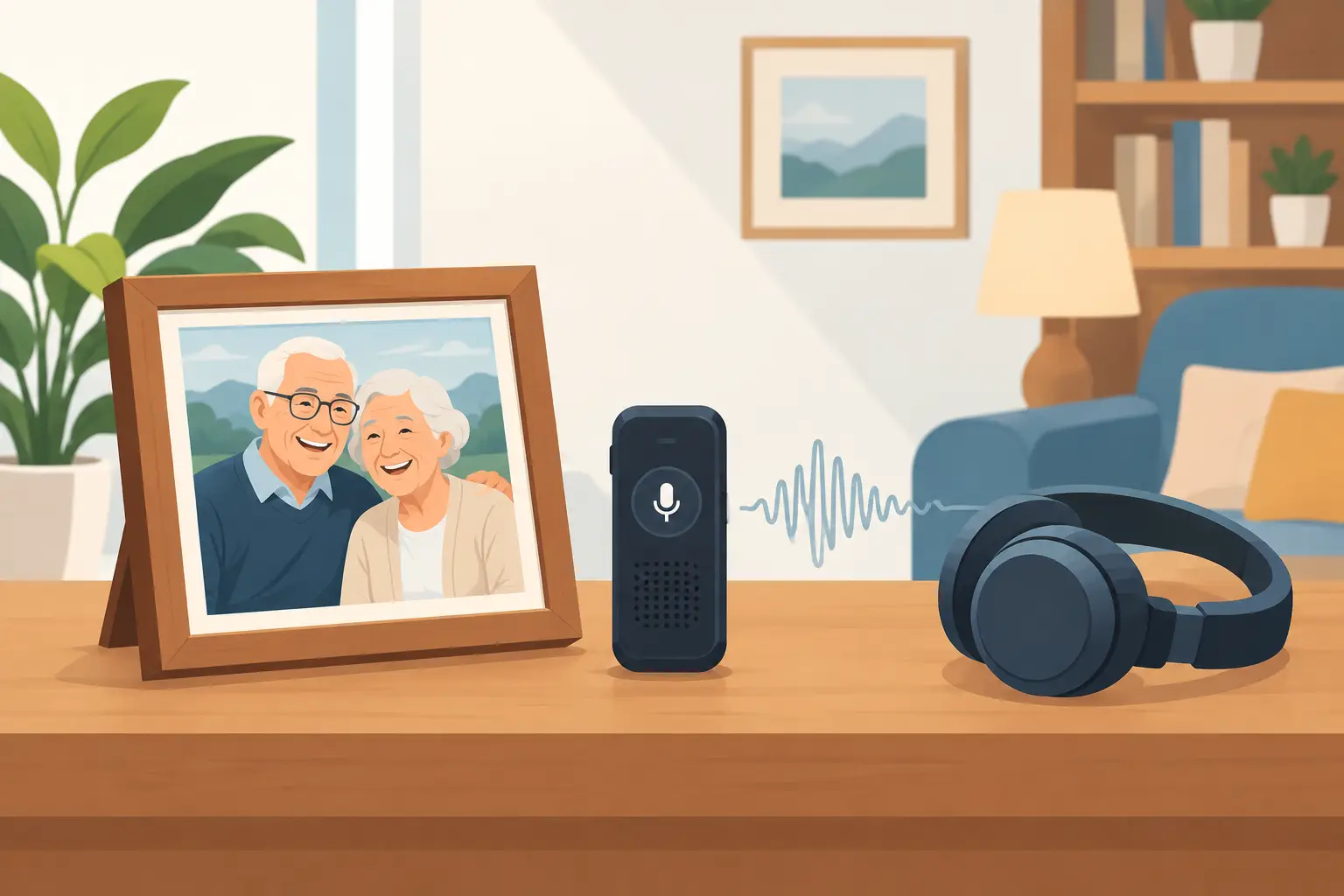
How to Preserve Grandparents' Voices at Home
Learn practical, gentle ways to preserve grandparents' voices, from easy, simple recordings to a private keepsake book your family can replay for years.
The words you remember may be small ones. The way your grandfather said your nickname. Your grandmother's laugh before she told a story she had told a hundred times. The pause before she answered a question about her own mother. To preserve grandparents' voices is to keep more than family facts. It is to keep the person behind them.
Photos can show a face. A written family tree can name a place and date. But neither can carry the rhythm of a familiar voice through a room years from now. That is why recording a grandparent's stories can become one of the most meaningful things a family does - especially when it is made simple enough to begin now.
Why a voice is different from a written memory
A written account of childhood may tell you that your grandmother grew up during the Depression or that your grandfather served overseas. Hearing them describe it gives the memory its shape. You hear what made them laugh, what still surprises them, and which details they return to without being asked.
Voice also preserves personality. Some grandparents are careful storytellers. Others wander, pause, correct themselves, or add an unexpected detail halfway through. Those moments are not mistakes to edit away. They are often what future generations will treasure most.
There is a practical reason to record, too. Memories do not disappear all at once. They can become harder to reach after an illness, a move, a loss of confidence, or simply the passing of time. A project started while the questions can still be answered does not need to be perfect. It only needs to begin.
Start with questions that invite a story
“Tell me about your life” can feel overwhelming, even for someone with a lifetime of memories. A smaller, more specific question is kinder. It gives your grandparent a place to start without making them feel like they are giving a speech or taking a test.
Ask about the home they grew up in. Ask what dinner smelled like when they were young, how they met their closest friend, or what they bought with their first paycheck. Ask what they wish their children had known about them when they were younger.
Questions about ordinary life often lead to the most vivid answers. A grandparent may not think a story about walking to school matters. Years later, a child or grandchild may hear an entire vanished neighborhood in that answer.
It helps to send one question at a time. That pace leaves room for reflection and removes the pressure of completing a large project in a single sitting. It can also make the experience feel like a conversation continuing over days or weeks, rather than an interview that must be finished.
Give permission to skip difficult subjects
Not every memory needs to be recorded. Some families have subjects that are painful, private, or complicated. A respectful life-story project gives the storyteller control over what they share.
You can say plainly, “Only answer what feels comfortable.” If a question brings up grief or family conflict, let it go. There are many ways to understand a person's life, and no recording is worth making someone feel exposed.
That same care applies to family history that involves other people. A grandparent may be happy to speak about their own experience but reluctant to tell another person's story. Let their boundaries set the tone.
Make recording feel easy, not technical
The best recording method is usually the one your grandparent will actually use. A studio microphone may create beautiful sound, but it can also make the process feel formal and intimidating. A phone, in a quiet familiar room, is often enough.
If you record together, place the phone nearby, silence notifications, and let the conversation move at its own pace. Do not interrupt every pause. People often remember something important a few seconds after they think they are finished.
If you live far apart, avoid making your grandparent download software, create an account, remember a password, or learn an unfamiliar app. Those steps can stop a meaningful project before the first answer is recorded. A private link that opens in a phone browser and leads to one recording button is much easier to accept.
Tell Me Forever is built around that approach. You choose or customize prompts, your loved one receives private one-question-at-a-time links, and they can record directly from their phone browser. Nothing to install. No account. No password.
Choose a time when they are comfortable
Timing matters as much as equipment. Some people are most talkative in the morning. Others come alive after dinner, when the day is quiet. A tired or distracted storyteller may give short answers, not because they have nothing to say, but because the moment is not right.
Keep early sessions short. Ten or fifteen minutes can be plenty. Ending while your grandparent still has energy makes it more likely they will want to continue. You can always collect more stories later.
Preserve the recording and the words together
Audio should be protected in more than one place. Save the original recording file, then keep a copy somewhere a trusted family member can access. Do not leave the only version on one person's phone.
A transcript is equally valuable. It makes stories easier to read, search, and share with relatives who may have hearing loss. It also protects details that might otherwise be missed when someone listens quickly. Names, places, recipes, and family sayings become easier to find.
Still, a transcript should not replace the audio. Reading “I was scared, but we managed” is different from hearing the softness, humor, or resolve in the voice that says it. The strongest family keepsake holds both forms together.
A printed book can give these stories a home that does not depend on a particular device or file format. When a scannable code beside a story plays the original recording, the page becomes more than a page. A future grandchild can read the memory, then hear it told by the person who lived it.
Do not wait for the perfect occasion
Many families put this off because they are waiting for a birthday, holiday, reunion, or a day when everyone can be present. Those occasions can be lovely, but they are not required. A Tuesday afternoon is enough.
You also do not need to know every question in advance. Start with one: “What do you remember about the house where you grew up?” Listen to the answer. The next question will often reveal itself.
There may be false starts. A recording may include a ringing phone, a forgotten name, or a story that takes an unexpected turn. Keep it anyway. Family history is not a polished documentary. It is a human voice making its way back to you.
Let the project belong to your grandparent
It is tempting to focus on what the family wants to know. Ask those questions, but leave room for what your grandparent wants to say. They may want to talk about a teacher who changed their life, a job they loved, a mistake they learned from, or the person they once hoped to become.
You can invite that freedom with a simple question: “Is there something you would like people in our family to remember?” The answer may be practical. It may be funny. It may be something no one has heard before.
One day, you will want to hear their voice again. Starting with one gentle question is a way of making sure you can.