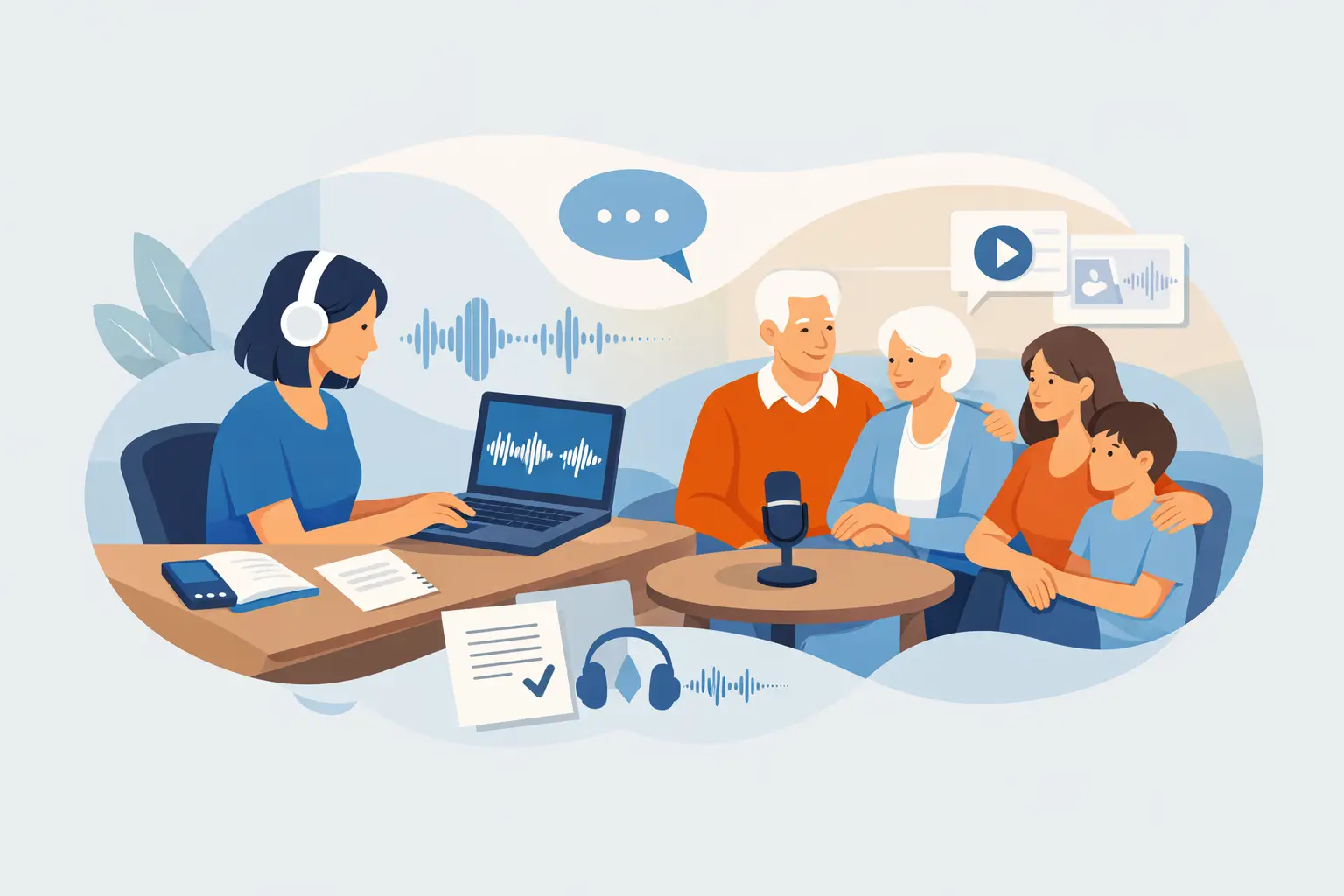
How to Transcribe a Family Interview With Care
Learn how to transcribe a family interview with practical steps for preserving words, voice, and the small details your family will treasure for years.
A family interview often contains the things no document can hold: the pause before your grandfather explains why he left home at 17, your mother’s exact laugh when she remembers her first job, the phrase your aunt has always used for a hard season. Knowing how to transcribe a family interview means giving those moments a form your family can return to, search, read, and share - without polishing away the person who told them.
Transcription does not need to turn a warm conversation into a formal historical record. The goal is simpler and more lasting: preserve what was said accurately enough that someone years from now can hear the person behind the page.
Start with a recording you can understand
A good transcript begins before anyone speaks. Find a quiet room, silence nearby televisions and notifications, and place the phone or recorder close enough to catch a natural speaking voice. You do not need a studio. A kitchen table, favorite armchair, or porch can be better places to talk because they feel familiar.
Ask one question at a time. Give your loved one room to think. Silence can feel long when you are sitting across from someone, but it often gives a story time to arrive. If a memory wanders, let it. The details that seem beside the point may be the details your family treasures most.
Before recording, ask for permission in plain language. Explain who may hear or read the story, where the recording will be stored, and whether they can change their mind about sharing something. This matters especially when conversations touch on grief, money, illness, war, family conflict, or private relationships.
Decide what kind of transcript your family needs
There is no single correct way to transcribe a family interview. The right level of detail depends on how you plan to use it.
A verbatim transcript captures nearly every spoken word, including repeated phrases, false starts, and fillers such as “um” or “you know.” It can be useful for research, legal records, or a project where speech patterns are central to the story. It also takes longer to create and can be tiring to read.
A clean-read transcript keeps the speaker’s meaning, tone, vocabulary, and memorable turns of phrase while removing most fillers and obvious repetitions. For a family history book, this is usually the best balance. “Well, I mean, we sort of moved, you know, in the fall” might become “We moved in the fall.” But if your grandmother says, “Oh honey, that was a different world,” leave it. That is not clutter. It is her voice.
An edited narrative goes one step further. It may reorganize sections, clarify timelines, and add brief notes for readers. This can make a story easier to follow, but it should be done carefully and, whenever possible, with the storyteller’s approval. Editing should clarify, not replace, their perspective.
How to transcribe a family interview step by step
Start by making a copy of the original audio file and store it somewhere private and reliable. Keep the untouched recording. Your transcript may be revised, but the original voice is irreplaceable.
Listen once without typing if you can. Make notes on the broad shape of the conversation: childhood, school, military service, meeting a spouse, raising children, work, traditions, losses, turning points. You will type more accurately when you understand where a story is going.
Then work in short sections, usually 20 to 60 seconds at a time. Pause, rewind, and type what you hear. Do not try to keep up in real time. Slow, careful work is more accurate than racing through a recording and guessing later.
Label speakers clearly when more than one person is talking. Simple labels work well:
Interviewer: What do you remember about the house on Maple Street?
Dad: Mostly the smell of my mother’s bread. She baked every Saturday.
If the interview is a single person answering prompts, you can use each question as a heading and place the response beneath it. This makes the finished transcript easier to read and helps relatives find a particular story later.
Add timestamps at natural breaks if the audio will remain part of the project. A timestamp such as [12:43] beside a story about a first car lets someone return to the exact recording quickly. You do not need one on every line. One every few minutes, or at the start of each new topic, is often enough.
When you cannot make out a word, do not invent it. Mark it as [inaudible] or [unclear], ideally with a timestamp. If you have the chance, ask the storyteller about it later. A guessed name, town, or date can quietly become family “fact” if it is left unmarked.
Keep the person in the words
The most common transcription mistake is overcorrecting. Family members often want a transcript to look polished, especially when it may become a printed keepsake. But grammar is not the same thing as voice.
Correct clear mistakes that make reading difficult, such as a repeated word caused by a stumble. Preserve meaningful wording, regional expressions, affectionate nicknames, and the rhythms that make the speaker recognizable. If your uncle calls a refrigerator an icebox, do not modernize it. If your mother says “we made do,” do not replace it with a more formal phrase.
Facts deserve gentle checking, but memory is not a test. Dates can blur. Two siblings can remember the same Christmas differently. If an important detail seems uncertain, you might add a note in brackets, such as [approximately 1958], rather than silently changing the account. The transcript should honor what the person remembers, even when another record tells a slightly different story.
Use technology as a first draft, not a final witness
Speech-to-text tools can save time, particularly with a long recording, but they make predictable mistakes. They may confuse names, places, accents, old brand names, overlapping voices, or a soft-spoken storyteller. They also miss the difference between “Aunt May” and “aunt made,” which can change a sentence entirely.
If you use automatic transcription, listen through the whole recording while comparing it to the text. Pay close attention to proper names, dates, military units, schools, addresses, and family relationships. Those are often the details future relatives will search for first.
Consider privacy before uploading audio anywhere. A family interview may contain sensitive information that was shared in trust. Know who can access the files, whether they will be retained, and how they may be used. Convenience is valuable, but it is not the only consideration.
For families who want the recording and written story kept together, Tell Me Forever records answers through a simple phone-browser link, with nothing to install, no account, and no password for the storyteller. The audio can live alongside the printed words, so readers can hear the story in the voice that gave it meaning.
Review it with kindness
Set the transcript aside for a day if possible, then read it while listening again. Check punctuation, speaker labels, names, and spots where the meaning became unclear. Reading it aloud can reveal sentences that accidentally lost their shape in transcription.
If your loved one is able and interested, invite them to review parts of it. Do not hand them a stack of pages and make it feel like homework. Read a favorite section together, or ask about a date you could not confirm. They may remember more once they see their own words on the page.
They may also want to remove something. Let them. A life story is a gift, not a claim on every memory. Respecting a boundary now protects the trust that made the interview possible.
Preserve both the transcript and the audio
A transcript makes memories usable. It can be printed, organized by theme, shared with relatives, and returned to on a quiet afternoon. Audio carries something the page cannot: breath, hesitation, humor, and the familiar sound of someone saying your name.
Save both in more than one private place. Use clear file names that include the storyteller’s name, topic, and recording date. Keep a brief note describing who conducted the interview and any editing choices you made. Years from now, that small bit of context will be useful.
You do not have to capture an entire life in one sitting. Begin with one question that feels easy: What was your childhood home like? What did your parents do for fun? How did you meet? The first transcript may not be perfect. It only needs to exist. One day, you will be grateful you can read the words. Even more, you will be grateful you can hear the voice behind them.