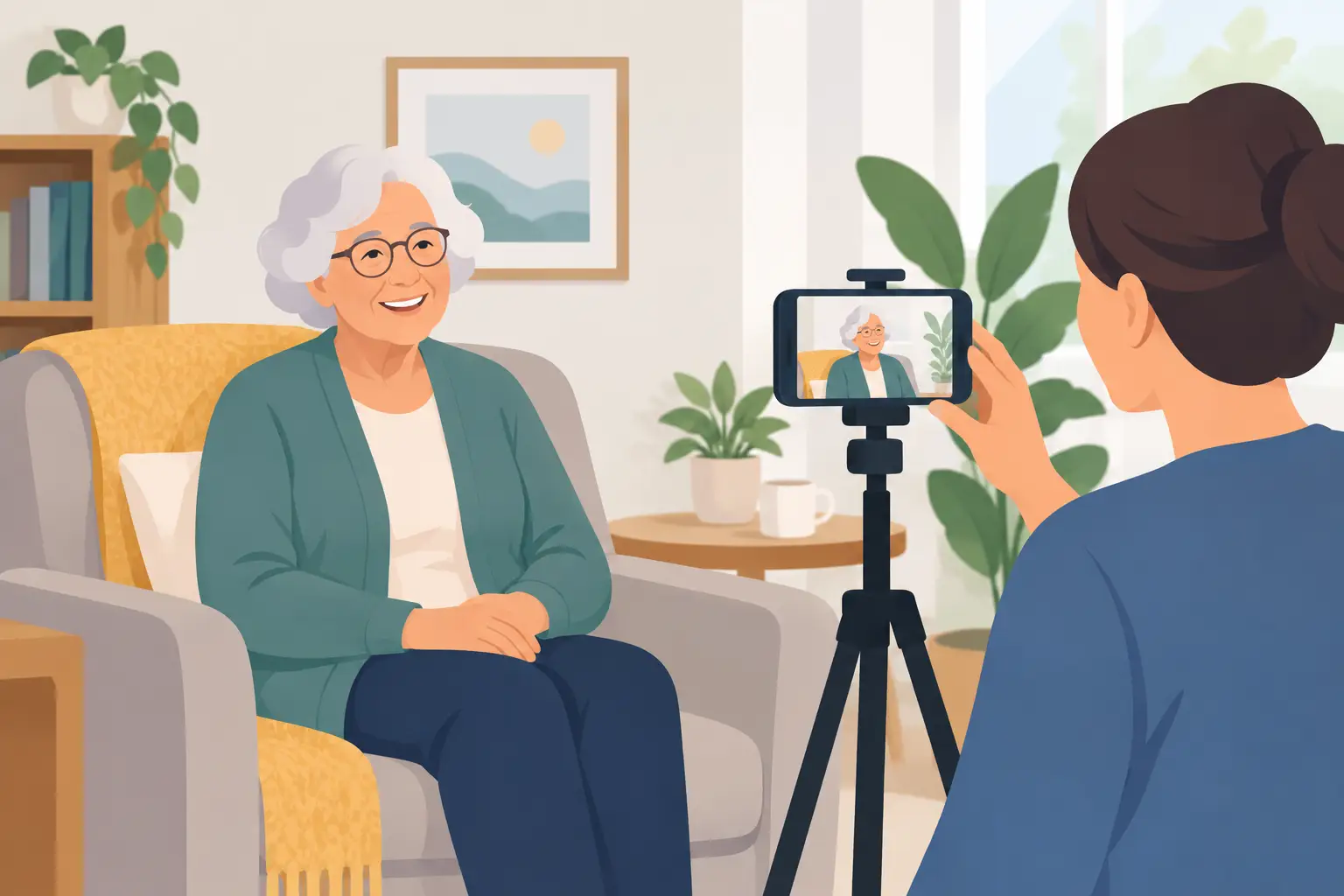
A Gentle Guide to Recording Elders at Home
This guide to recording elders helps families preserve voices, memories, and everyday stories with simple questions and no pressure or technical hurdles.
The best time to begin a guide to recording elders is rarely when the house is quiet, everyone is prepared, and the right questions are printed. It is often after Sunday dinner, during a drive home, or when your mother mentions the job she had before she met your father. You realize you have never heard the full story. One day, you will want to hear her voice again.
Recording an older relative is not about producing a perfect documentary. It is about making room for the stories that usually pass by in conversation: the smell of a childhood kitchen, a first apartment, a hard season, a joke that has lasted fifty years. A simple recording can hold details no family tree or photograph ever could.
Start with comfort, not a microphone
The word “interview” can make people feel examined. Your parent or grandparent may worry about saying the right thing, remembering dates, or being recorded at all. Start by explaining that there are no wrong answers. They do not need to tell their whole life story in one sitting. You are simply saving a few memories in their own words.
Choose a familiar, quiet place. Their kitchen table, favorite chair, or porch may work better than a carefully arranged setup. Turn off the television, silence phones, and avoid recording when they are tired or rushing to another commitment. If hearing is a concern, sit close enough to speak naturally and keep background noise low.
Ask permission before you begin recording, even if they have already agreed to the project. A small moment of consent sets the tone: “Would you still feel comfortable if I recorded this story?” It reminds them that the story belongs to them.
Some people are happy to speak freely. Others need time to warm up. It depends on personality, health, family history, and the subject itself. Do not mistake a hesitant first answer for a lack of stories. Often, a person needs a gentle question and the reassurance that you are not in a hurry.
Choose questions that invite a story
Questions with a single factual answer can be useful, but they rarely open the door very far. “Where were you born?” gives you a place. “What do you remember seeing from the window of your childhood home?” may bring back a whole neighborhood.
Begin with subjects that feel safe and concrete. Childhood games, school lunches, first jobs, family holidays, music, pets, and early friendships are good places to start. These memories can build confidence before you move toward more personal topics.
A helpful guide to recording elders makes room for both major events and ordinary life. Families often ask about weddings, military service, careers, and moves across the country. Those matter. But the ordinary details are often what future generations treasure most: how Grandpa took his coffee, what Grandma wore to work, the song played at family parties, or the advice a parent heard from their own mother.
Try open prompts such as, “Tell me about the house you grew up in,” or, “What did a good day look like when you were young?” Follow their lead. If they mention a sibling, ask what that sibling was like. If they laugh, let the laughter stay in the recording. A voice carries warmth, timing, and personality in a way written words alone cannot.
Avoid treating the conversation like a checklist. It is fine to have questions ready, but listen for the story underneath the answer. A planned question can wait if a different memory has come alive.
Make the recording easy enough to repeat
The best recording method is the one your loved one will actually use more than once. A phone is often enough. Modern phones record clear audio when they are placed nearby in a quiet room. Put the phone on a stable surface rather than holding it, and keep it within a few feet of the speaker. Record a short test first and play it back together.
Long sessions can be tiring, especially for someone managing pain, fatigue, or memory changes. Twenty minutes may be plenty. Ten minutes may be better. A series of short conversations is easier to return to, and it gives memories time to surface between sessions.
If you live far away, do not let distance become the reason the project waits. A simple browser-based recording process can be less intimidating than a video call or an unfamiliar app. Tell Me Forever, for example, sends one private question at a time through a link. The storyteller can record an answer directly from a phone browser, with nothing to install, no account, and no password.
That simplicity matters. When technology becomes the focus, the story can disappear behind it. Before relying on any method, consider whether your loved one can use it independently, whether you will be available to help, and whether the recordings remain private and easy for your family to keep.
Let difficult memories stay in their own hands
Not every meaningful story is happy. Older relatives may have lived through grief, war, illness, discrimination, estrangement, financial hardship, or losses they have rarely discussed. You do not need to avoid the truth, but you should never press for it.
Use invitations rather than demands. “Was there a time that changed how you saw the world?” gives someone room to decide what to share. If they pause, change the subject, or say they would rather not talk about it, accept that answer without trying again in the moment.
You can also offer control over what happens next. Ask whether they want to hear the recording, revise a detail later, keep a story only within the immediate family, or leave a subject out entirely. Memory is personal. Recording it should not take that ownership away.
Be especially thoughtful when several relatives may remember the same event differently. Your goal is not to settle every disagreement. It is to preserve one person’s experience in their own voice. A remembered story can be emotionally true even when a date, name, or sequence is imperfect.
Save more than the audio
A recording is precious, but it deserves a safe home. Name each file clearly with the storyteller’s name, topic, and date. Keep copies in more than one place, such as a computer and a secure cloud folder. Let at least one other trusted family member know where the recordings are stored.
Written transcripts make stories easier to read, search, and share, particularly for relatives who cannot easily listen to audio. Still, do not replace the original recording with text. A transcript can preserve the words. The audio preserves the pause before an answer, the familiar laugh, and the way someone says a family nickname.
Consider gathering a few photographs, recipe cards, letters, or captions to sit beside the stories. You do not need to create a large archive all at once. One story with one photo can be enough to begin. Over time, these pieces can become a book that feels personal rather than polished beyond recognition.
Be present without taking over
When recording a parent or grandparent, it is tempting to fill in gaps, correct details, or answer for them. Resist that urge when you can. Silence is not failure. A person may be searching for the right memory, deciding what they want to reveal, or simply enjoying the thought of it.
Your role is to be attentive. Nod. Ask a gentle follow-up. Say, “I never knew that,” when it is true. If they lose their place, offer a small prompt instead of moving on too quickly. The aim is not to capture every fact. It is to help them feel heard.
And if the first attempt feels awkward, that is normal. The second question is usually easier than the first. So is the next visit, the next call, the next small opening in an ordinary day. Begin with one question while you still can, and let their voice lead you from there.