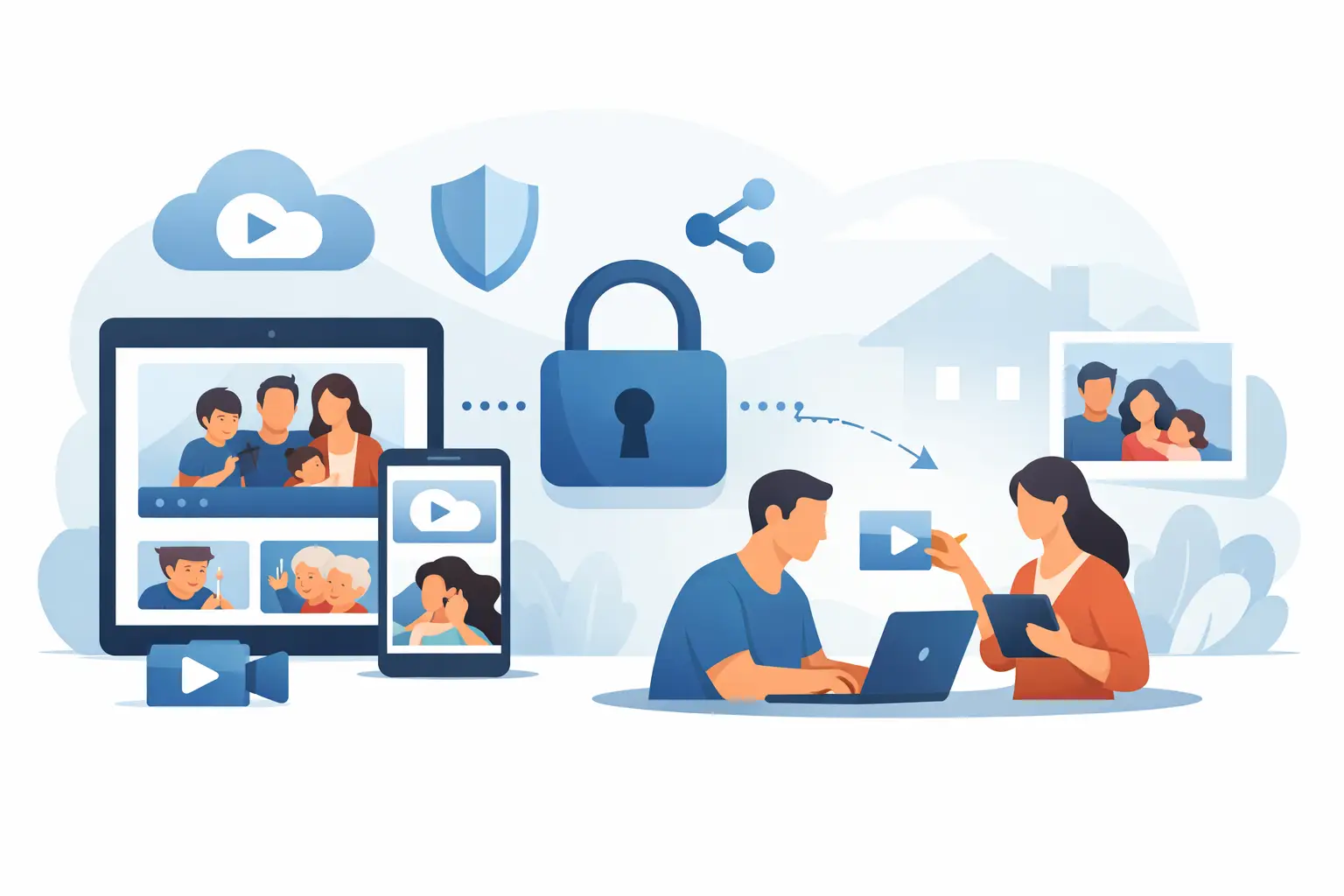
How to Share Family Recordings Privately
Learn how to share family recordings privately, protect a loved one's voice, and give relatives an easy, meaningful way to listen in private, with care.
Her laugh is still there. So is the pause before she tells the story about meeting your grandfather, the detail nobody else remembered, and the way her voice changes when she speaks about home. When you are deciding how to share family recordings privately, the goal is not simply to move audio from one phone to another. It is to let the right people hear something irreplaceable without making it public, complicated, or exposed.
Family recordings often hold more than stories. They may include grief, old conflict, medical details, childhood memories, or a relative's honest view of events. Privacy gives the storyteller dignity. It also gives the family room to listen closely, without the pressure of an audience.
Start with the storyteller's wishes
Before choosing a folder, app, or sharing method, ask one quiet question: who does this person want to hear these recordings?
Some storytellers are happy for every child, grandchild, and close friend to listen. Others may want certain answers kept within a smaller circle. A memory about a first job might be easy to share widely. A story about a difficult marriage, estrangement, adoption, illness, or loss may not be. There is no single rule, and there does not need to be.
It helps to agree on simple categories before recording begins. You might decide that most stories can be shared with immediate family, while a few are for children only or for the storyteller alone unless they later say otherwise. Write those decisions down in plain language. This prevents a loving intention from turning into a painful misunderstanding later.
Consent can change, too. A person may feel comfortable recording a story in the moment and decide afterward that they do not want it shared. Make it clear that they can revise, remove, or keep an answer private. That reassurance often makes people more willing to speak freely.
How to share family recordings privately without making it hard
The best private-sharing method is one your family will actually use. If your father needs to create an account, remember a password, download software, and learn a new interface before he can tell a story, the technology has become the subject. It should stay in the background.
For the person recording, simplicity matters most. A private, one-question-at-a-time recording link can be especially gentle for an older parent or grandparent. There is nothing to install, no account, and no password. They open the link in a phone browser, press one recording button, and answer in their own time.
For the people listening, privacy means controlled access. Avoid posting recordings to public social media, public video channels, or a broadly searchable family website. Even a private group can become less private when invitations are forwarded, screens are shared, or settings change over time.
A good approach gives you a clear answer to three questions: who can listen, how do they receive access, and what happens if someone should no longer have it?
Use small, intentional sharing circles
Not every recording needs the same audience. Create a core group for the full collection, then share selected stories with a wider circle when it feels right. This may mean siblings and adult children receive access to everything, while cousins receive a few lighter recordings for a reunion or birthday.
This approach is not about secrecy. It is about context. The people closest to a story are often best able to hold it with care.
If family relationships are strained, be specific rather than assuming everyone understands the boundary. Instead of saying, “Please keep this private,” say, “This recording is for the three of us. Please do not forward it or post clips.” A clear request is kinder than an unspoken expectation.
Treat private links like house keys
A private link is convenient because it removes barriers. It can also be forwarded. If a recording service uses secure private links rather than logins, share them only through direct messages or emails with the intended recipient. Do not place them in a public family newsletter, a social media post, or a group thread that includes people you do not know well.
Ask recipients not to forward the link. If you are sharing by email, use individual messages for especially sensitive stories rather than one large group email. It takes a little longer, but it gives you more control and makes the request for discretion feel personal.
For highly sensitive recordings, choose a method that lets you change access later or replace a link if needed. Convenience and control are a trade-off. A password can add protection, but it can also create frustration for relatives who rarely use technology. The right balance depends on the story and the listener.
Keep the original recordings in a safe place
Private sharing is not the same as preservation. A link, phone, or inbox can disappear. Keep original audio files and transcripts in at least two places you control, such as a trusted cloud storage account and an external drive stored at home.
Give one or two dependable family members instructions for finding the collection. Include the name of the service or storage location, the email address connected to it, and any steps needed to access the files. You do not need to hand out every password today, but someone should know where the stories live if you are unavailable.
It is also wise to keep a simple index. List each recording by the question it answers, the storyteller's name, and the date it was recorded. A file called “audio-final-7” will mean very little years from now. “Mom on leaving Ohio in 1964” will bring people back to the moment immediately.
Let the recording stay connected to the story
Audio matters because it carries what a transcript cannot fully hold: the pacing, the breath before a difficult sentence, the warmth in a familiar phrase. But written words make stories easier to read, search, and return to during a quiet afternoon.
That is why a paired format can be so meaningful. Tell Me Forever turns spoken answers into a printed life-story book, with a scannable code beside each story that plays the original voice. The book can sit on a shelf or be held at a kitchen table. The recording remains private to the people you choose, while the story has a physical home that is less likely to be lost in an old phone.
Before printing or distributing anything, give the storyteller or a trusted family reviewer time to listen and read. Small edits may be needed for names, dates, or details that were spoken casually. More importantly, this is the moment to notice an answer that should stay out of the shared book or be reserved for a smaller audience.
Be careful with recordings after someone dies
When a loved one dies, relatives often want to hear their voice right away. That longing is natural. It can also lead to quick decisions made while everyone is grieving.
If possible, follow the sharing wishes discussed earlier. If there were no clear instructions, begin with the smallest reasonable group, usually immediate family, and give everyone time. You can always share more broadly later. It is much harder to pull back a recording once it has been copied, posted, or sent beyond the family.
Avoid editing a person's words into short social clips unless you are confident they would have welcomed that use. A tender 20-second moment may feel meaningful to one relative and deeply private to another. Listening together in a family room, on a phone call, or through a private recording collection can be a more respectful first step.
Make privacy part of the invitation
The way you introduce a recording shapes how it is received. A short note can set the tone: “Grandpa answered this question for us. Please listen somewhere quiet, and please keep it within the family.” That is enough. You do not need legal language to ask for care.
You can also invite replies without asking people to distribute the original. A grandchild might send back a voice message saying, “I never knew that about you.” A sibling may write down a detail the recording brought back. This keeps the exchange personal rather than turning a family memory into content.
One day you may want to hear her voice again, not as a clip caught in a crowded camera roll, but in the full shape of a story she chose to tell. Share it thoughtfully now, and the people who love her can return to it for years without taking it beyond the family circle.