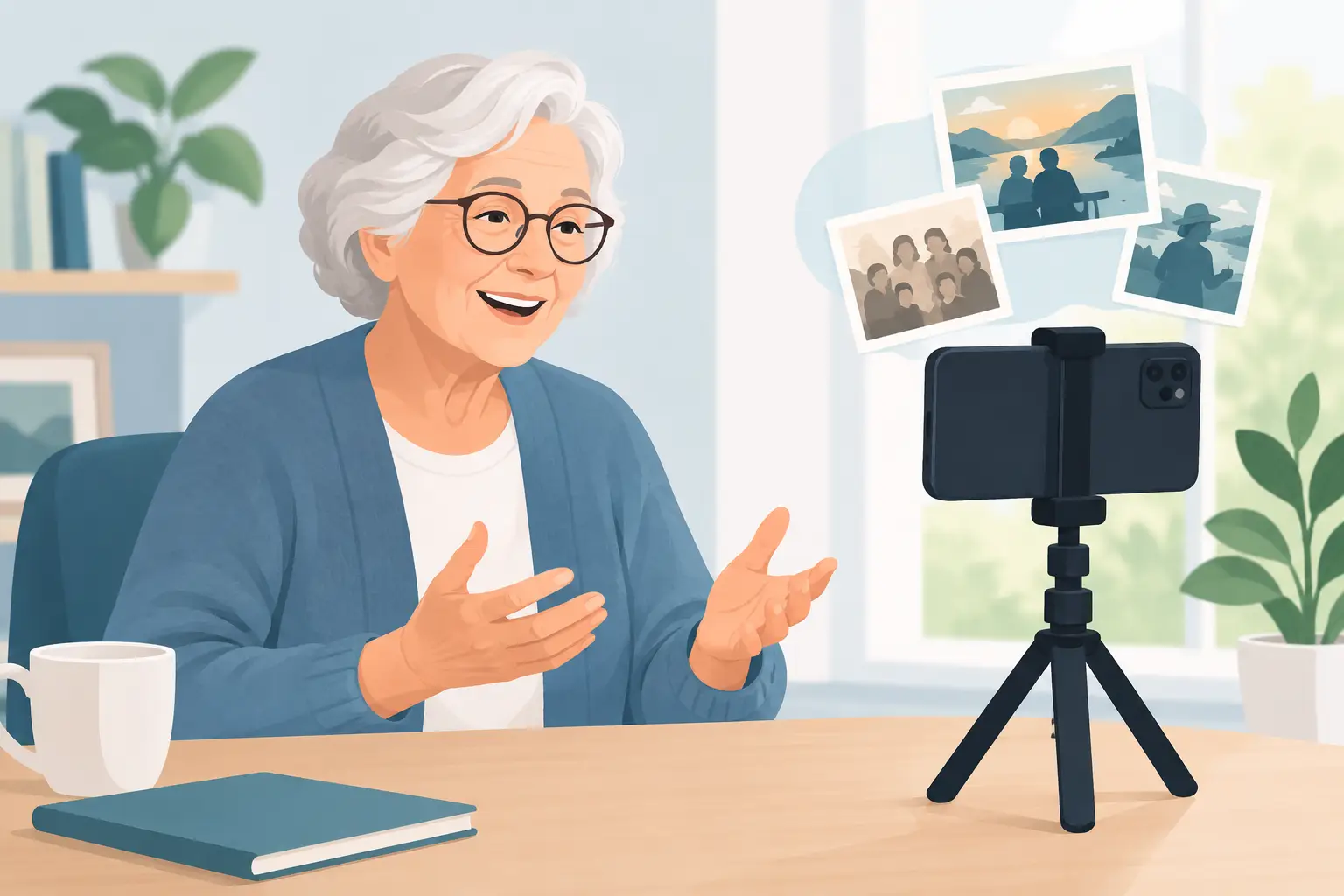
Can Seniors Record Their Stories With Ease?
Can seniors record meaningful memories without learning new technology? A simple phone link can preserve their voice, story, and wisdom for family now.
The question is not only, can seniors record their stories? It is whether the process feels comfortable enough that they will want to. A parent may have decades of memories to share, but hesitate at the sight of a new app, a password screen, or a tiny button that seems easy to press only for someone else.
The good news is that recording a life story does not have to feel technical. With the right setup, an older adult can speak into the phone they already use, answer one thoughtful question at a time, and leave behind something their family can return to for years. No performance is required. No polished speech. Just their own voice telling the stories only they know.
Can seniors record without being comfortable with technology?
Yes, often more easily than families expect. The barrier is rarely a lack of stories. It is usually the process surrounding the story.
Many older adults are perfectly capable of using a phone but do not want to download unfamiliar software, create an account, remember another password, or worry that they are doing something wrong. If recording involves several screens, technical instructions, or a video call at a set time, even an eager storyteller may put it off.
A simpler approach removes those decisions. Send one question in a private link. The storyteller opens it in a phone browser, sees the question, presses one recording button, and speaks. Nothing to install. No account. No password.
That small difference matters. A grandmother who would never describe herself as "good with technology" may happily talk for ten minutes about the first house she and her husband bought. A father who says he does not know what to say may have plenty to say once the question is specific: What did your own father teach you about work? What did summer smell like when you were a child? How did you meet Mom?
The best recordings feel like a conversation
A life-story recording should not feel like an oral exam. The goal is not to capture every date correctly or create a perfect autobiography in a single afternoon. The goal is to make room for a person to remember out loud.
Specific prompts are gentler than broad ones. "Tell me your life story" can be overwhelming, even for someone with a full and vivid life. A single question gives the mind somewhere to begin. Once a memory opens, it often carries the storyteller naturally into details nobody else in the family has heard.
Consider questions that invite scenes rather than summaries. Ask about the kitchen where they grew up, the first job they held, a favorite holiday tradition, a hard decision, a sibling's sense of humor, or the moment they realized they had become an adult. These questions do more than collect facts. They preserve perspective.
Their answer may wander. That is often where the good part is. The pause before a name, the laugh after a family joke, the way they correct themselves halfway through a story - those are pieces of a person, not mistakes to remove.
Give them permission to keep it simple
Some seniors worry about saying the "right" thing. It helps to say plainly that there is no right answer and no need to prepare. They can record in short sessions. They can skip a question they do not want to answer. They can stop and come back another day.
A quiet room is useful, but it does not need to be a studio. Sitting near a window, away from a running television or dishwasher, is usually enough. Headphones are optional. A familiar phone and a comfortable chair matter more.
If hearing, vision, arthritis, or fatigue makes phone use harder, a family member can help with the practical first step. Open the link, adjust the volume, or place the phone nearby. Then step back if that gives the storyteller more freedom to speak honestly. Help should make the process easier, not turn it into a production.
Why audio matters as much as the words
A written transcript is valuable. It makes stories easy to read, search, share, and keep. But a transcript cannot hold a person's voice.
One day, you may want to hear the rhythm of your mother's sentence when she talks about her first dance. You may want to hear your grandfather pause before describing military service, or laugh when he remembers a childhood prank. Audio carries warmth, hesitation, humor, accent, and feeling. Those details can be hard to explain to children and grandchildren who never had the chance to know the storyteller well.
That is why recording now can matter even when the conversation seems ordinary. The stories that feel familiar today may become the ones your family reaches for later.
There is a trade-off, of course. Audio can feel more vulnerable than writing. Some people speak freely but dislike seeing themselves on video. Others prefer to collect their thoughts in writing. Recording only the voice is often a middle ground: personal and alive, without the pressure of being on camera.
A private process can make honesty easier
Family stories can include joy, grief, estrangement, mistakes, and subjects someone has not discussed for years. A storyteller should always control what they share.
Choose a process that lets them answer privately and at their own pace. They should not have to post stories publicly or join a social network to preserve them. They should be able to skip questions, rerecord an answer if they wish, and decide which memories belong in the finished collection.
It also helps to avoid treating the project as a deadline-driven interview. Instead of saying, "We need to get all of this done this weekend," try, "I would love to hear one story whenever you feel like it." A few minutes after breakfast can be more meaningful than a long, tiring session arranged around a holiday gathering.
Not every question needs an answer. Silence can be a boundary, and a respectful family project makes room for that.
A practical way to begin
Start with a small set of questions that sound like your family. You might begin with childhood, the people who shaped them, love and friendship, work, traditions, or lessons they hope to pass along. Keep the first question easy and concrete. Momentum matters more than ambition.
Tell Me Forever was built around this kind of low-pressure experience. A family chooses or customizes questions, and the storyteller receives private, one-question-at-a-time links. They record directly from a phone browser, with nothing to install, no account, and no password. The recordings can be transcribed and made into a printed book, with a scannable code beside each story that plays the original voice.
For some families, a physical book is the part that makes the project feel real. It can sit on a shelf, be passed around at a gathering, or become a gift for siblings and grandchildren. For others, downloadable recordings and transcripts matter most. Neither choice is more meaningful. What matters is that the stories are saved in a form your family will actually revisit.
Do not wait for the perfect occasion
Birthdays, anniversaries, and holidays can be lovely reasons to begin, but they are not requirements. You do not need a milestone to ask your dad what he remembers about his mother. You do not need a formal occasion to hear how your grandmother got through a difficult year.
Often, the best time is an ordinary Tuesday when you finally decide that the stories are worth making time for. Send one question. Let them answer when they are ready. Then listen closely - not only for the history, but for the person behind it.