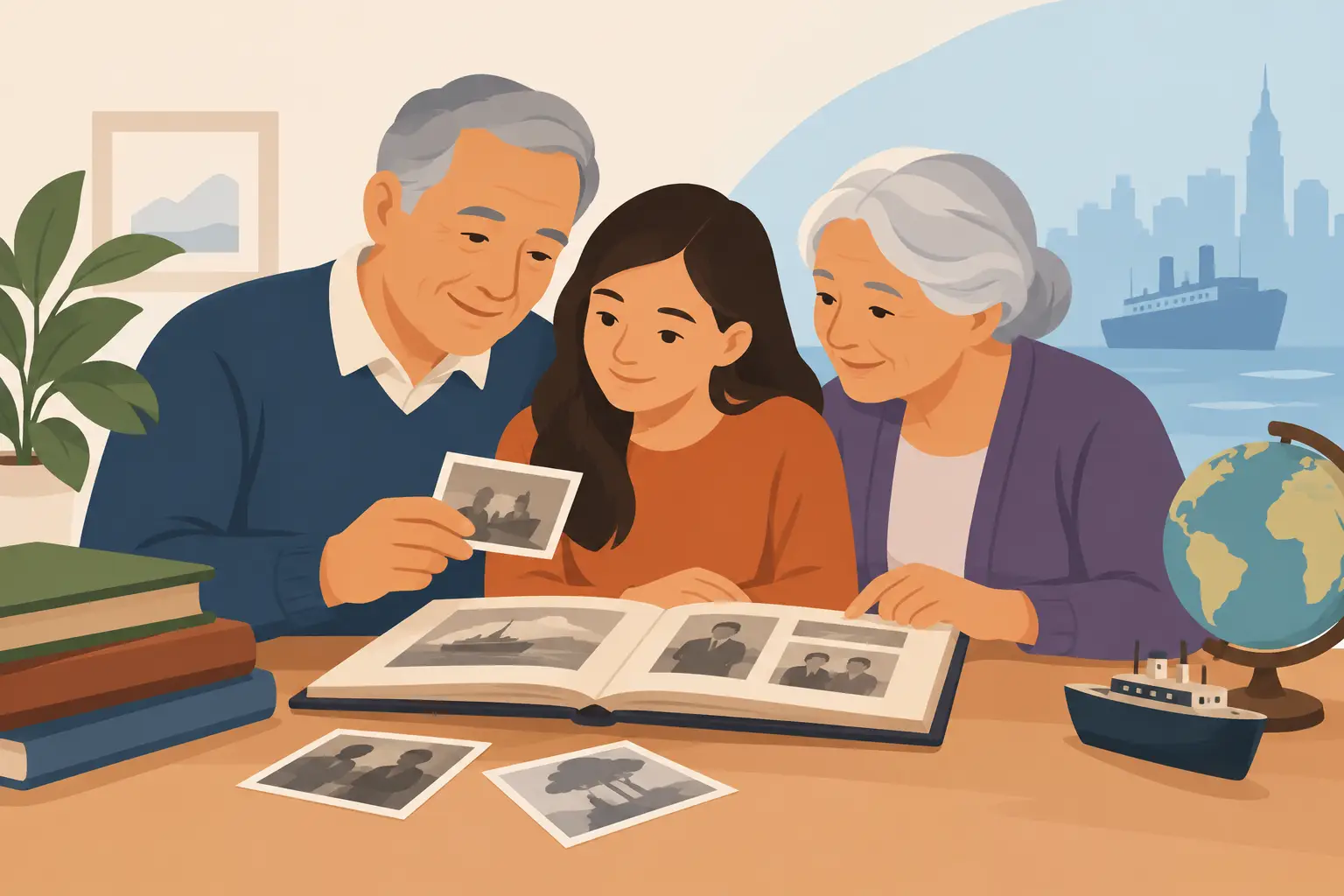
How to Preserve Stories From Immigrant Grandparents
Stories from immigrant grandparents hold the details that family records miss. Learn which questions to ask and a way to preserve their voices for good.
A surname on a census record can tell you where a family came from. It cannot tell you what your grandfather saw from the ship, why your grandmother kept one recipe exactly as her mother made it, or what it felt like to speak a new language all day and return home exhausted. Stories from immigrant grandparents carry the human part of a family history: the choices, losses, jokes, compromises, and small acts of courage that records leave out.
These conversations can feel overdue, especially when a grandparent is older or when immigration has been a difficult subject in the family. The good news is that you do not need to conduct a formal interview or know every detail of their past. You only need a gentle place to begin, enough time to listen, and a way to keep what they share.
Why these stories are easy to lose
Immigration stories are often told in fragments. A grandparent may mention a childhood village while cooking, describe their first job during a holiday visit, or laugh about misunderstanding an American phrase decades ago. Family members hear these moments and assume they will ask about them later.
Later has a way of becoming too late.
Some grandparents also minimize what they lived through. They may say, “It was nothing,” because hardship was ordinary to them, because they do not want to burden their children, or because they have spent years looking forward rather than back. That does not mean the story lacks value. Often, the details they think are ordinary are exactly what future generations will want to know.
The goal is not to turn your grandparent into a historical exhibit. It is to let them be a whole person: someone who missed home, made friends, learned new routines, made mistakes, and built a life that changed yours.
Start with stories from immigrant grandparents, not facts
Dates, ports, documents, and family names matter. But beginning with facts can make a conversation feel like a test. Start instead with memories that invite a scene.
Ask, “What do you remember most clearly about the home where you grew up?” rather than “What year did you leave?” Ask, “What did a regular school day look like?” or “What food did you miss when you first arrived?” These questions give your grandparent room to decide what matters.
When they mention something you do not recognize, stay with it. “Tell me more about that street,” or “Who was there with you?” can open a door. A single follow-up question may bring out the name of a neighbor, the sound of a market, or the feeling of holding a parent’s hand in a crowded station.
If you are not sure how much they want to discuss the move itself, ask permission plainly. You might say, “I would love to understand that part of your life, but only if you are comfortable talking about it.” Respecting a pause or a change of subject is part of preserving a story with care.
Questions that make room for a real answer
Good prompts are specific enough to spark a memory but open enough to avoid steering the answer. Consider asking:
- What was your neighborhood like when you were young?
- Who taught you the skills or values you still use today?
- What did you bring with you when you left, and what did you have to leave behind?
- What surprised you most about your new home?
- When did this place begin to feel familiar?
- What traditions did you work hard to keep for your children?
- What do you wish your grandchildren understood about where our family began?
Not every question will fit every family. Some moves were chosen; others were shaped by war, poverty, political danger, adoption, separation, or limited options. A question about leaving may feel natural for one person and painful for another. Let their answers set the pace.
Make space for the complicated parts
A meaningful family story does not need to be polished into a tale of constant bravery. Your grandparent may remember loneliness, discrimination, money worries, or a period when they felt caught between two cultures. They may also remember opportunity, relief, and a deep pride in the life they made.
Those feelings can exist together.
Try not to correct, compare, or rush toward a lesson while they are speaking. If a detail differs from what another relative has said, write it down as their memory. Family history often has more than one honest version. What matters is that their voice has a place beside the documents and stories you already have.
Language can be part of that care, too. Many people tell their richest stories in the language of childhood. If your grandparent is more comfortable answering in Spanish, Korean, Italian, Tagalog, Arabic, or another language, let them. A translated summary may be useful later, but their original phrasing, cadence, and humor are worth keeping.
Record the voice, not just the information
A written transcript preserves what was said. A recording preserves how it was said: the long pause before a difficult memory, the laughter after an old family joke, the accent grandchildren know by heart. One day, those sounds may matter as much as the story itself.
Recording does not need to be technical. Choose a quiet time when your grandparent is comfortable and not rushed. Keep the first session short, perhaps one or two questions. Let them know they can stop, redo an answer, or skip anything they do not want included.
For families who live far apart, a guided service can remove the practical obstacles. Tell Me Forever sends private, one-question-at-a-time links that open in a phone browser, with nothing to install, no account, and no password for the storyteller. Their spoken answers can become a printed book with the original audio available beside each story. That simplicity can be especially helpful when you want the focus to stay on the memory, not the technology.
Whatever method you use, keep the recordings private and be clear about who will hear them. Ask whether there are stories they want shared only with immediate family, or not shared until a certain time. Giving your grandparent control builds trust and often leads to more honest conversations.
Let the project unfold over time
You do not have to capture an entire life in one afternoon. In fact, trying to do so can make the process feel overwhelming for everyone. Begin with an easy memory, then return to the conversation another day.
A story about a first apartment may later lead to a story about a first friend. A remembered holiday might bring back a parent’s advice or a recipe no one has written down. Leave room for these connections. The most moving accounts often appear after a person has had time to think between questions.
It also helps to invite other family members to contribute gently. A cousin might share an old photograph and ask who is in it. An adult child may remember a phrase their parent said often. These prompts can jog memories, but the storyteller should remain at the center. This is not a debate about the past. It is an opportunity to hear them tell it in their own words.
What future generations will receive
Your children or grandchildren may never walk the streets your grandparent knew first. They may not speak the same language or cook every dish exactly the same way. Still, they can know that someone before them crossed a border, started over, and carried certain hopes into an unfamiliar place.
That knowledge can make a family feel larger and more connected. It can also make a grandparent feel seen now, not only remembered later.
Choose one question and ask it while you can. Then listen past the first answer. The next sentence may be the story your family has been waiting to hear.