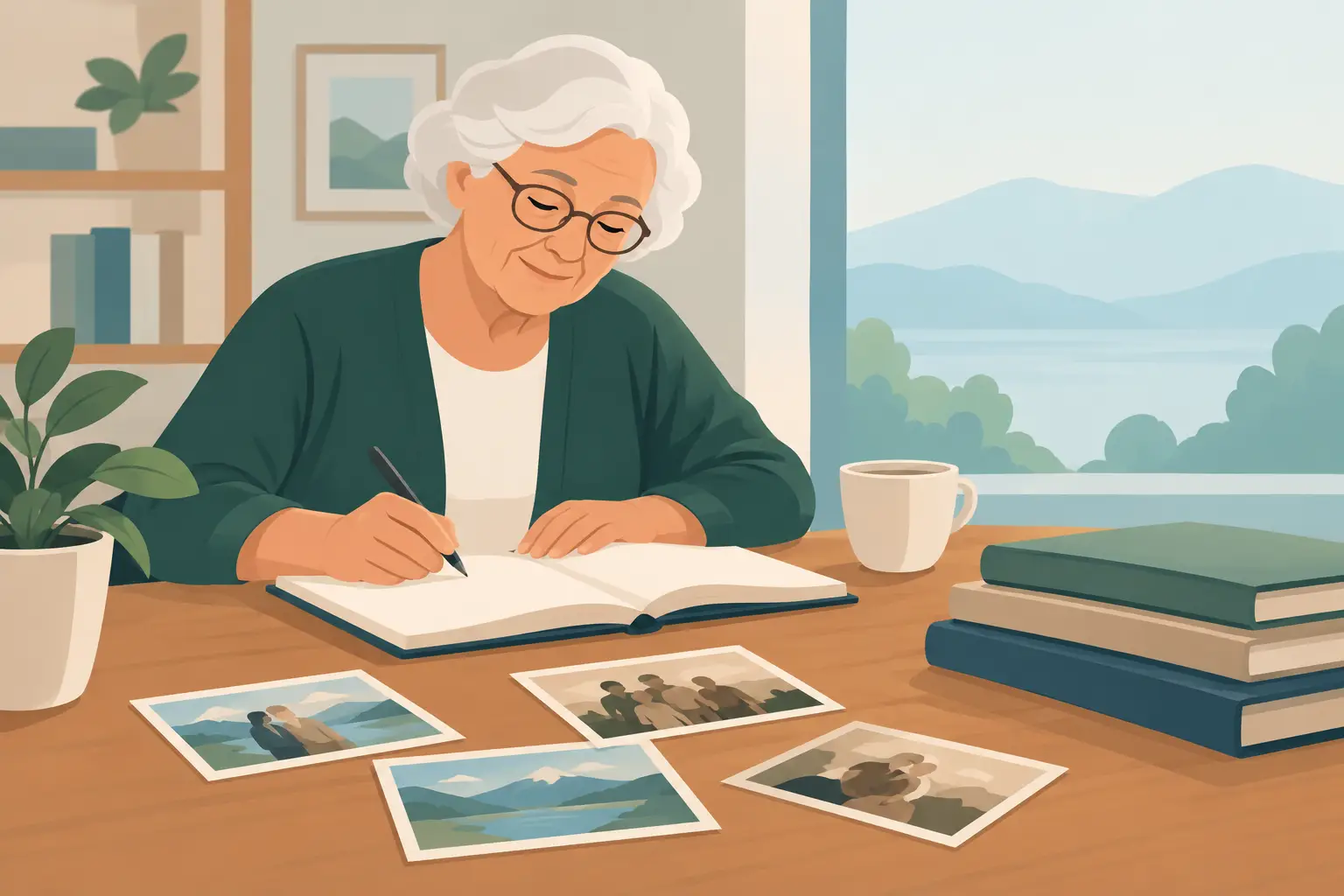
An Elder Memoir Guide for Preserving a Life
An elder memoir guide for preserving stories, voices, and everyday details with gentle questions, simple recording, and a book your family can keep close.
A good elder memoir guide does not begin with a blank page and the pressure to tell an entire life perfectly. It begins with one small question: What do you remember about the house where you grew up? A familiar memory often leads to another. Before long, you may hear about a mother’s cooking, a first job, a hard winter, a beloved sibling, or the person your parent was before you knew them.
That is the real purpose of a memoir. Not to produce a complete historical record. Not to turn someone you love into a polished writer. It is to keep the stories, details, and voice that belong to one irreplaceable person.
Start with the memories only they can tell
Families often wait because the project feels large. A parent may say they have nothing interesting to share. A grandparent may worry they will not remember dates. Both concerns are understandable, and neither needs to stop the conversation.
The memories that matter most are rarely the ones found in official records. You can look up a wedding date or the town where someone lived. You cannot look up how it felt to leave home at 18, what song was always playing in the car, or why your grandfather chose the work he did. You cannot recreate the sound of your mother laughing as she tells the story.
Start with subjects that feel close to the storyteller’s own life. Childhood, school, work, friendships, family traditions, military service, faith, moves, love, parenting, and favorite meals all offer natural openings. Some people prefer to begin with a happy memory. Others find that talking about a difficult chapter gives shape to everything that followed. Let them set the pace.
A memoir does not have to be chronological. In fact, a strict timeline can make a person feel as though they are being tested. A collection of meaningful moments is often warmer, easier, and more revealing.
Choose questions that invite stories, not short answers
The quality of an elder memoir often comes down to the questions. Broad questions such as “Tell me about your life” can be overwhelming. Specific prompts give a person somewhere to begin.
Instead of asking, “What was your childhood like?” try, “What did a normal Saturday look like when you were young?” Rather than “Tell me about your career,” ask, “What was your first paycheck for, and what did you do with it?” A question about a kitchen, a neighborhood, a teacher, or a family car can bring back details no one expected to hear.
Good prompts leave room for the storyteller to decide what matters. They do not assume every family was close, every memory was happy, or every person wants to discuss private pain. If a question feels too personal, skip it. If an answer brings up something tender, pause before moving on.
Questions worth asking
Consider questions like these as starting points:
- What is one of your earliest memories?
- Who made you feel safe when you were young?
- What did your family do when someone had good news?
- What job taught you the most about yourself?
- When did you feel most independent?
- What family saying do you still hear in your head?
- What do you hope younger members of the family understand about your life?
Follow-up questions are where many of the best stories live. “What happened next?” “Who was there?” and “What did that feel like?” are simple invitations, not interruptions.
Make recording easy enough to say yes to
The right format depends on the person. Some elders enjoy handwriting and want time to revise. Others speak more freely than they write. For many families, spoken answers are the gentlest place to start because conversation feels natural and does not require perfect spelling, typing, or a long stretch of concentration.
Keep sessions short. Ten or fifteen minutes can be enough for one meaningful story. Asking for too much at once can turn a loving project into homework. A regular rhythm works better than a marathon: one question this week, another next week, and time between them to remember more.
Technology should stay out of the way. If your loved one is comfortable with a phone, the process can be as simple as opening a private link and pressing one recording button. Nothing to install, no account, and no password. That matters. A story can disappear behind a forgotten login or an unfamiliar app before it ever has the chance to be told.
Tell Me Forever is built around this lower-pressure approach. A family chooses or customizes prompts, and the storyteller receives one private question at a time by email. Their spoken answers can then be transcribed and shaped into a printed book, with a scannable code alongside each story to play the original recording.
Preserve the voice, not just the words
Written transcripts are valuable. They make stories easy to read, share, and revisit. But a transcript cannot hold every part of a voice.
It cannot fully capture the pause before a hard truth, the quickness of an old joke, the accent that has softened over time, or the way someone says a childhood nickname. One day, those sounds may matter as much as the facts themselves. For children and grandchildren who never had enough time with a loved one, hearing that voice can make a person feel present again.
When you record, choose a quiet room if possible. Turn off the television and silence phone notifications. There is no need for studio equipment. A clear, comfortable voice in an ordinary room is more precious than a perfect recording that never gets made.
If your loved one loses their train of thought, wait. Do not rush to fill the silence. Memories often arrive slowly. It is also fine to stop and come back another day. The goal is not efficiency. It is to make room for a person to be heard.
Handle sensitive stories with care
Every life contains chapters that are complicated. Divorce, grief, illness, estrangement, financial hardship, war, and loss may be part of the story. So may family details that one person wants to share and another would rather leave private.
Discuss boundaries early. Ask the storyteller who should be able to hear or read the memoir, and whether there are stories they want saved for the family but not included in a printed book. Give them control over what is recorded, edited, or omitted. A memoir should never feel like an extraction of family information.
It also helps to remember that memory is personal. Two siblings may remember the same home differently. Your role is not to correct every detail. If dates or names need clarification, you can gently check them later. But preserve the storyteller’s point of view. Their experience is the story.
Turn scattered stories into something lasting
A box of recordings is better than losing the stories altogether, but a finished keepsake makes it more likely that the family will return to them. A book gives the project a home. It can sit on a shelf, be passed around at a holiday gathering, and become a quiet way for younger relatives to meet someone beyond the role of Mom, Dad, or Grandpa.
As you organize the material, use simple sections such as Early Years, Family Life, Work and Purpose, Lessons Learned, and Messages for the Future. Do not over-edit the language until it sounds unlike the person who spoke it. Clean up obvious repetitions if desired, but keep their expressions, humor, and rhythm. Those are part of the inheritance.
Include photographs only if they add something. A photo of a first home, an old school portrait, or a wedding day can anchor a story. Yet words and audio can stand on their own. The absence of photographs should never become a reason to postpone beginning.
Begin before the perfect moment arrives
You may feel awkward asking these questions at first. Your loved one may be modest, distracted, or unsure why anyone would want to listen. Start anyway, gently. Say what is true: “I want to know more about your life.” “I want the kids to hear this from you.” “I do not want these stories to disappear.”
You do not need to finish a memoir in one season, and you do not need the perfect list of questions. One story is enough to begin. Ask it while you can, listen without hurrying, and keep the answer somewhere your family can return to for years.