How to Turn Audio Recordings Into a Book
Learn how to turn audio recordings into a book that holds a loved one's words and voice, with simple questions, private links, and a keepsake to share now.
A recording on a phone can hold far more than information. It catches the pause before your dad tells a story he has told a hundred times. It keeps your grandmother's laugh, the rhythm of her voice, and the exact way she says a family nickname. When you turn audio recordings into a book, you do not have to choose between the permanence of the written word and the living presence of a voice. You can keep both.
For many families, the hard part is not caring about the stories. It is beginning before another holiday, another busy season, or another year passes. A simple, guided process can make that first step feel manageable for everyone involved.
Start with questions that invite stories
A life story rarely arrives in order. Asking, “Tell me your life story,” can leave even a wonderful storyteller unsure where to begin. Specific questions are kinder. They give someone a doorway into a memory without making the conversation feel like an interview.
Begin with the moments your family will want to understand one day: childhood homes, first jobs, friendships, family traditions, military service, moves, losses, celebrations, and lessons learned. Then make room for the small details that do not appear in official records. What did Sunday morning smell like in the house where she grew up? What did he spend his first paycheck on? Which relative made everyone laugh?
A good set of questions also follows the storyteller's comfort. Some people are ready to speak about difficult periods. Others would rather start with lighter memories. There is no need to force a complete account of a life. The goal is not a perfect historical document. It is an honest collection of stories in their own words.
If you are choosing questions for a parent or grandparent, keep each one focused. One question at a time gives a person room to think, remember, and speak naturally. It also means they can answer when they feel rested, rather than setting aside an afternoon for a formal recording session.
Make recording easy enough to say yes to
The best recording method is usually the one a loved one will actually use. A complicated app, a new password, or a long list of instructions can turn a meaningful gift into another task to avoid. This matters especially when a storyteller is not comfortable with technology.
A low-friction approach lets them receive a private link, open it in their phone browser, and press one recording button. Nothing to install. No account. No password. They can listen back if they wish, then send the answer when it feels right.
This is also easier on families. You do not need to be in the room for every memory, and your loved one does not need to wait until you are available to continue. A question can arrive by email, and an answer can be recorded during a quiet morning, from a favorite chair, at their own pace.
There are trade-offs. A live conversation can produce lovely follow-up questions and unexpected stories. If your family member is eager to talk, sitting together with a phone or recorder may be the right choice. But a private, one-question-at-a-time format often helps people who feel self-conscious, tire easily, or simply need time to remember. Many families use both: a few shared conversations, then guided questions for everything else.
Keep the spoken voice and the written page together
Transcription gives a recording shape. It makes stories easier to read, revisit, search, and share with relatives who may not be able to listen right away. It also creates a book that can sit on a shelf, be passed around at a family gathering, or be opened years from now by someone who never had the chance to meet the storyteller.
But a transcript alone cannot carry everything. It cannot fully show the warmth in your mother's voice when she describes meeting your father, or the quiet in your grandfather's voice when he talks about a brother. That is why audio belongs alongside the text whenever possible.
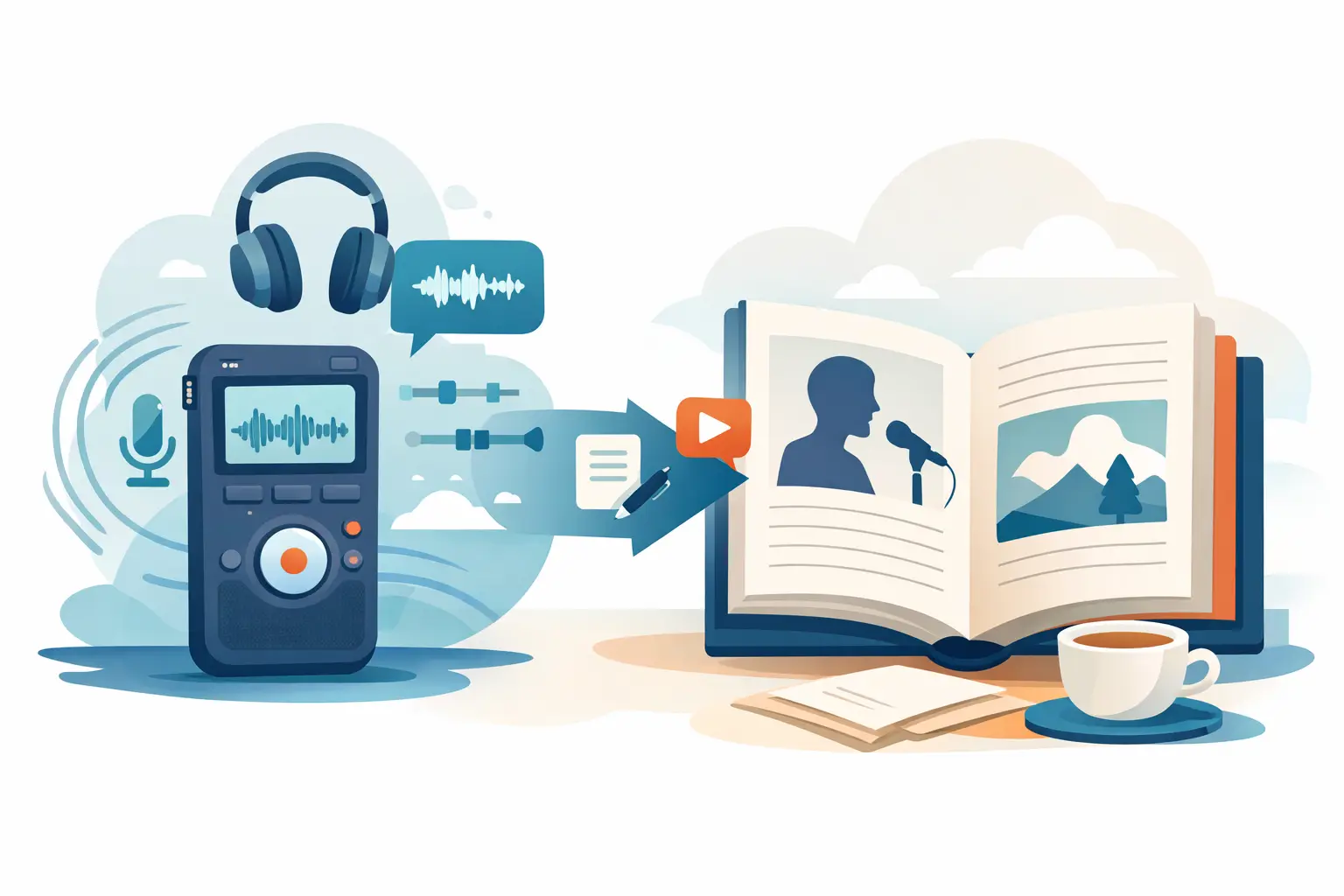
One thoughtful format places a scannable code beside each written story. A reader can scan the code with a phone and hear the original recording while following along on the page. The written story gives the memory a lasting home. The audio gives it breath.
Before a book is printed, transcripts should be reviewed with care. Speech does not always arrive on the page exactly as it should be read. Names may need correcting. A phrase may have been misheard. Some storytellers will want to remove a private detail, while others will want to leave in the natural repetition that makes the memory sound like them.
Editing should protect the person's meaning, not polish away their personality. A book of family stories should still feel like the person who told them.
Decide what belongs in the book
Not every recording needs to become a chapter. A shorter book centered on 20 or 30 strong stories can be more inviting than a large collection that tries to include every answer. On the other hand, a family with many relatives, long recordings, or a rich archive may want a more expansive volume.
A natural structure might move through childhood, young adulthood, family life, work, turning points, and reflections. Or it may be organized by themes such as love, home, faith, food, travel, and advice. There is no single correct order. Some of the most moving pages come from an ordinary story placed beside a larger one: a favorite recipe next to a memory of making it with a parent, or a childhood game beside a story about the neighborhood where it was played.
Consider including photographs if they add context, but do not delay the project while searching for the perfect images. The voice and stories are enough. Photos can deepen a book, yet the recording itself may be the most irreplaceable part.
Choose a physical format that matches how the book will be used. A paperback can be easy to share among a large family. A hardback can feel especially suited to a milestone gift or a permanent family library. Keep digital copies of the recordings and transcripts as well. A printed book is a beautiful object; saved files give the family another layer of access and protection.
Protect privacy without making the process heavy
Personal history can include sensitive material: health, grief, relationships, finances, conflict, or memories that belong only to the immediate family. Talk with the storyteller about what they are comfortable sharing and who should receive the finished book.
Private access matters. The stories do not need to be posted publicly to be meaningful. A service such as Tell Me Forever is built around private recording links and keepsake books, so a loved one can speak freely without joining a public network or learning unfamiliar software.
It is also wise to set gentle expectations early. Let the storyteller know they can skip a question, redo an answer, or say, “I would rather not include that.” Permission makes better stories possible. People often speak more openly when they know they are not being pressured to perform or reveal everything.
Begin before the project feels perfect
Families often postpone this because they imagine a large production: special equipment, a formal interviewer, a complete family tree, and months of planning. Those things can be valuable in some circumstances, but they are not required to preserve what matters.
Start with one question. Ask about the home they grew up in, the first person they loved, or a day they wish the family could have seen. Send the link. Listen to the answer. The next question will come more easily.
One day, you may want to hear their voice again. A book made from their recordings gives you a way to return not only to what they remembered, but to the person who remembered it.